
Code-Switching in Kids: Is It a Problem or a Sign of Progress?

You’re reading a bedtime story in English, and your child suddenly pipes up: “Mami, el dinosaur está eating all the leaves!” Sound familiar? If you’re raising a bilingual child, it probably does. And here’s the thing: that adorable language mash-up isn’t a mistake. It’s actually a sign that something incredible is happening inside your child’s brain. Code-switching in kids, the practice of moving between two languages within the same conversation or sentence, is one of the most misunderstood behaviors in bilingual development.
Many parents worry that it means their child is confused, falling behind, or not learning either language “properly.” We hear this concern all the time at BabyFe. And every time, we’re happy to share the same reassuring truth: research is firmly on your child’s side.
In this article, we’ll break down exactly what code-switching is, why bilingual children do it, what the science says about it, and how you can support your child’s language journey with confidence. By the end, you might just find yourself celebrating the next time your little one switches languages mid-sentence!
What Exactly Is Code-Switching in Kids?
Code-switching refers to the practice of alternating between two or more languages within a single conversation, sentence, or even a single phrase. It’s not random, and it’s definitely not accidental. Even very young children who code-switch do so with an intuitive logic, reaching for the most accessible or expressive word available to them in both languages.
It can look a few different ways. Sometimes a child switches between sentences, answering a question in Spanish and then asking a follow-up in English. Other times, it happens within a single sentence, like inserting one language’s word into the grammatical structure of another. Both patterns are completely normal and well-documented in bilingual language acquisition research.
Here are a few real-life examples parents might recognize:
“Quiero the blue one.” (I want the blue one.)
“Mi amigo said it was funny.” (My friend said it was funny.)
“Yo tengo homework.” (I have homework.)
One thing code-switching is NOT: a sign of language delay. This distinction is important, and we’ll come back to it. But first, let’s look at why it happens in the first place.
Why Do Bilingual Children Code-Switch?

The bilingual brain is always active. When a child knows two languages, both systems are essentially “on” at the same time, not competing, but co-existing and cooperating. Code-switching happens for several very natural reasons:
Filling a vocabulary gap: A child may simply know a word in one language but not yet in the other. Reaching across languages is efficient, not lazy.
Emotional resonance: Some words or phrases carry more emotional weight in one language. Many bilingual adults report that certain feelings just "fit better" in one tongue over another.
Social context: Children are incredibly socially aware. They pick up on which language someone speaks, and code-switching can be a way to connect with the listener.
Cognitive efficiency: The brain reaches for the most accessible word in the moment. This is especially common when one language is dominant at a particular time of day or in a specific setting.
Peer influence and identity: As children grow, code-switching can become a way of expressing cultural identity and belonging, especially in diverse school environments.
The key takeaway here is that code-switching is purposeful. It’s the bilingual brain doing exactly what it was built to do: flexibly draw on multiple linguistic resources to communicate as effectively as possible.
Is Code-Switching a Sign of Language Confusion?
Short answer: No. Absolutely not.
This is the most common fear parents bring to us, and it’s also one of the most thoroughly disproven. Linguists and child development researchers have studied bilingual language acquisition for decades, and the consensus is clear: children who code-switch are demonstrating knowledge of both language systems, not confusion between them.
A child who is genuinely confused about language doesn’t code-switch; they struggle to communicate in either language. Code-switching, by contrast, requires the child to navigate the grammar and vocabulary of two separate systems simultaneously. That’s not confusion. That’s sophistication.
So what does actual language delay look like? Children with language delays (in any language) may show:
Very limited vocabulary in both languages combined
Difficulty forming simple sentences by age 3
Trouble understanding instructions in either language
Significant regression in language use
Code-switching looks nothing like this. If you do have concerns about your child’s language development, a bilingual speech-language pathologist is the right professional to consult, someone who understands that assessing a bilingual child in only one language gives an incomplete picture.
The Cognitive Benefits Hidden Inside Code-Switching
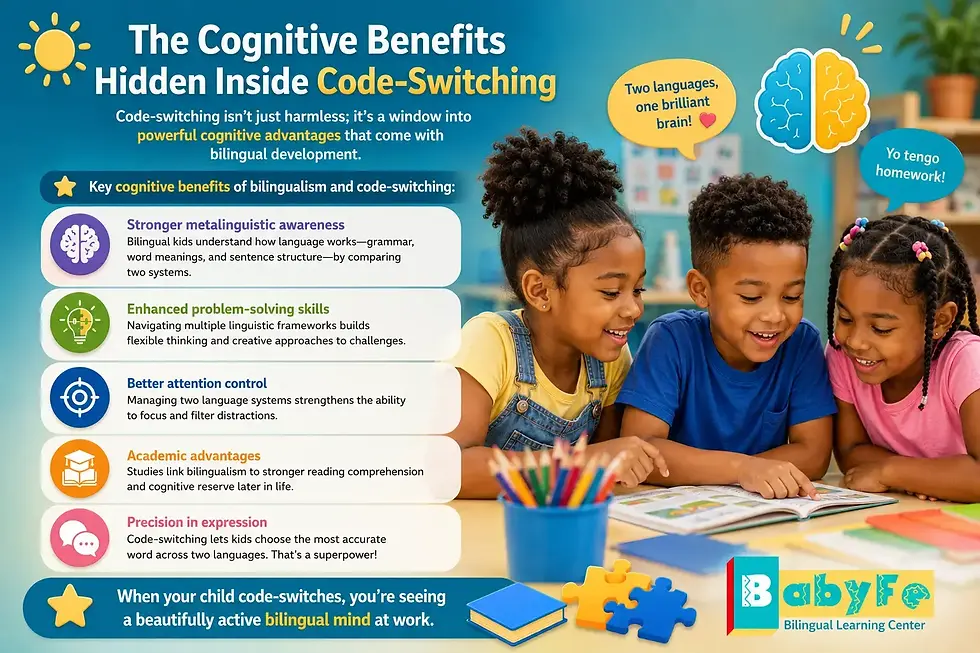
Here’s where it gets really exciting. Code-switching isn’t just harmless; it’s actually a window into some powerful cognitive advantages that come with bilingual development.
Managing two active language systems requires the brain’s executive function to work constantly. Executive function covers skills like attention, mental flexibility, and the ability to switch between tasks, all of which are exercised every time a bilingual child chooses which language to use or fluidly moves between them. Research has shown that bilingual children often demonstrate advantages in these areas compared to their monolingual peers.
Some of the key benefits tied to bilingualism and code-switching include:
Stronger metalinguistic awareness: Bilingual kids develop a deeper understanding of how language itself works, grammar rules, word meanings, and sentence structure because they’re constantly comparing two systems.
Enhanced problem-solving skills: Navigating multiple linguistic frameworks builds flexible thinking and creative approaches to challenges.
Better attention control: The constant management of two language systems strengthens the ability to focus and filter distractions.
Academic advantages: Studies have linked bilingualism to stronger reading comprehension and cognitive reserve later in life.
Precision in expression: Code-switching allows a child to draw on the most accurate word available across two whole languages. That’s not a limitation; it’s a superpower.
When you see your child code-switch, you’re not seeing a gap in their learning. You’re seeing a beautifully active bilingual mind at work.
How Parents and Caregivers Can Support Healthy Code-Switching
Now that we know code-switching is normal and even beneficial, the question becomes: how can parents nurture it? Here’s what the research and our experience at BabyFe suggest.
Don’t correct or shame it.
The instinct to say “Speak in Spanish” or “Use English properly” can unintentionally send the message that bilingualism is a problem. It isn’t. Correcting code-switching can actually discourage children from speaking altogether. Instead, model the language naturally.
Establish language-rich contexts.
Some families use a “one parent, one language” approach. Others set Spanish at home and English at school. Whatever your approach, consistency in language environments helps children develop stronger foundations in both. Over time, their vocabulary in each language grows, and with it, the need to code-switch naturally decreases.
Celebrate both languages equally.
Read bilingual books together. Play music in both languages. Share cultural traditions that are rooted in each. When children see both languages honored and celebrated, they develop pride in their bilingual identity rather than ambivalence about it.
Validate the behavior out loud.
When your child code-switches, try responding with enthusiasm instead of correction: “Yes! Mariposa is a butterfly, you know it in both languages! That’s amazing!” This kind of affirmation builds vocabulary in both languages while reinforcing that bilingualism is a gift.
Consider a structured bilingual learning environment.
At BabyFe, our bilingual immersion curriculum is designed around exactly this kind of intentional, structured language exposure. Children hear and use both Spanish and English throughout their day in a context that’s developmentally appropriate, playful, and consistent. A quality bilingual early childhood program can significantly strengthen vocabulary development in both languages, which is one of the best long-term supports for healthy bilingual development.
What Code-Switching Looks Like at Different Ages
Code-switching evolves as children grow, and understanding what’s typical at each stage can help parents feel more confident in what they’re seeing at home.
Toddlers (ages 1–3): Code-switching at this stage is mostly single-word borrowing. Your toddler knows “leche” but not yet “milk,” so they use the word they have. This is completely expected and simply reflects which language has been more dominant in a given context.
Preschoolers (ages 3–5): Language mixing becomes more complex and begins to follow grammar rules from both languages. Children this age are also starting to pick up on social cues, noticing that grandma speaks Spanish and their teacher speaks English, and adjusting accordingly. This social awareness is a cognitive achievement!
Early school-age (ages 5–8): Code-switching becomes more purposeful. Children have larger vocabularies in both languages now, so switching is less about filling gaps and more about expression and context. Peer influence plays a bigger role, especially in diverse school environments.
Older children (age 8+): At this stage, code-switching can become an intentional expression of cultural identity and community belonging. Many bilingual adults carry this into their adult lives, and research suggests this kind of active bilingualism supports cognitive health long-term.
Parents often ask us: “Will my child ever just speak one language at a time?” The answer is: yes, as vocabulary in both languages grows, code-switching naturally decreases and becomes more deliberate. The goal isn’t to eliminate it, it’s to support both languages so the choice is always available.
At last, a quality Spanish immersion preschool can be especially impactful at this stage.
Code-Switching Is a Strength, Not a Setback
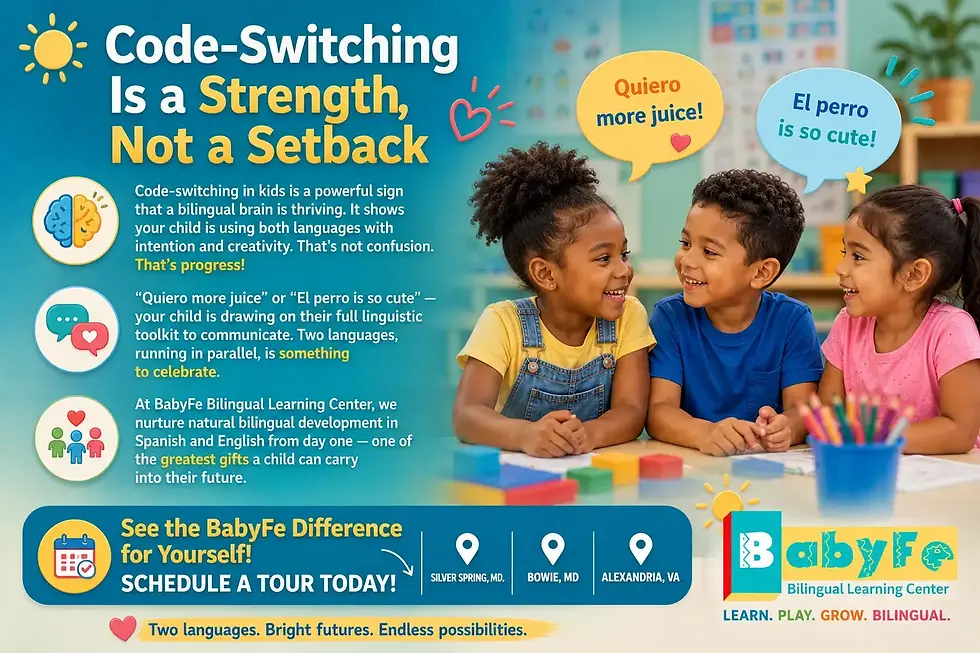
So, is code-switching in kids a problem? Not even a little bit. It’s one of the most fascinating, research-backed signs that a child’s bilingual brain is thriving. It shows that your child is actively engaging with both language systems, drawing on their full linguistic toolkit to communicate, and that’s something worth celebrating.
The next time your little one says “Quiero more juice” or “El perro is so cute,” take a moment to marvel at what’s happening inside that growing brain. Two languages, running in parallel, are being used with intention and creativity. That’s not confusion. That’s progress.
At BabyFe Bilingual Learning Center, we build our entire curriculum around supporting this kind of rich, natural bilingual development, in Spanish and English, from the earliest years. We believe bilingualism is one of the greatest gifts a child can carry into their future, and we’re here to nurture it every step of the way.
Curious about how BabyFe supports bilingual development from day one? We’d love to show you our classrooms and share our approach in person. Schedule a tour at our Silver Spring, Bowie, or Alexandria location, and see the BabyFe difference for yourself.



Comments