
Preschool for 2-Year-Olds: Daily Routines, Learning Goals, and Activities (2026)

Is your toddler ready for preschool? If your little one is two years old and bursting with curiosity, you're probably wondering where even to begin. The good news? Two-year-olds are incredible learners, and the right preschool for 2 years old environment can make a world of difference in their development.
Here's a stat that might surprise you: according to child development research, children who attend high-quality early education programs before age three show measurably stronger language, social, and cognitive skills by kindergarten. That's huge!
In this guide, we're breaking down everything parents and educators need to know about preschool for 2-year-olds, from what a healthy daily routine looks like to the key learning goals your child should be hitting, to activities that are as fun as they are developmental. Whether you're a parent exploring options or a teacher building your curriculum, you're in the right place. Let's dive in!
Is Your 2-Year-Old Ready for Preschool? Signs to Look For
One of the most common questions parents ask is: "Is my child even ready for this?" The honest answer is, readiness looks different for every child. But there are some reliable signs that your toddler might be ready to thrive in a preschool setting.
Most 2-year-olds are hitting a fascinating phase of development. They're starting to string two or three words together, they're showing a genuine curiosity about the world around them, and they're beginning to notice, and care about, other children. These are all fantastic signs!
Developmental milestones to watch: By 24 months, most toddlers can say around 50 words, follow simple two-step instructions, and engage in basic pretend play. These are strong indicators that a child can participate meaningfully in a preschool setting.
Separation tolerance: Your toddler doesn't need to be completely comfortable being away from you; this skill develops over time. But if they can handle short separations (like with a grandparent or babysitter) without prolonged distress, that's a positive sign.
Basic communication ability: Children who can express basic needs, hunger, discomfort, wanting to play, even through pointing or simple words, tend to adjust better to the preschool environment.
Curiosity and interest in other children: Does your child light up when they see other kids? Do they reach out or try to engage? This social curiosity is a wonderful readiness signal.
The difference between 'readiness' and 'perfection': No two-year-old should be expected to sit still for long stretches, share without conflict, or regulate every emotion. That's what preschool is FOR, to develop these skills, not to require them upfront.
When to consult a specialist: If you have concerns about your child's language development, social engagement, or sensory processing, speaking with a pediatrician or early childhood specialist before enrollment can give you valuable guidance and peace of mind.
What to Look for in a Preschool Program for 2-Year-Olds
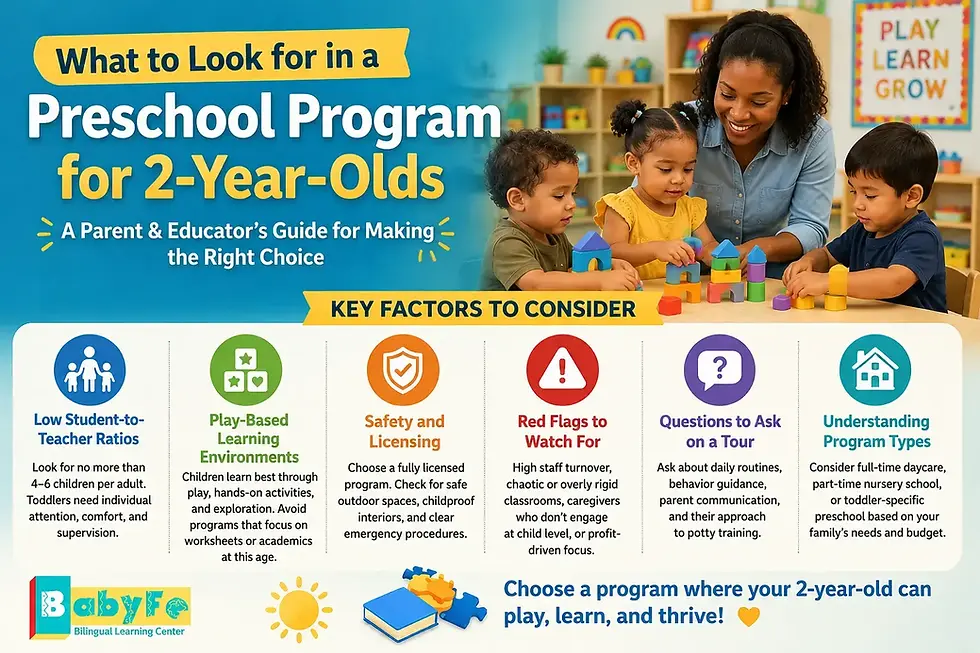
Not all preschool programs are created equal, and for two-year-olds especially, the quality of the environment matters enormously. When you're touring programs, you're not just looking at cute classrooms and finger paintings on the wall. You're evaluating whether this space is truly safe, nurturing, and developmentally appropriate for a child who is still in a very dependent, emotional stage of growth.
Low student-to-teacher ratios: For 2-year-olds, look for a ratio of no more than 4–6 children per adult. Toddlers need individual attention, comfort, and supervision. A room with 20 kids and two adults is not ideal for this age group.
Play-based learning environments: At two years old, children learn best through play, hands-on, exploratory, and child-led. Be cautious of programs that emphasize desk work, worksheets, or academic drills for toddlers. The research overwhelmingly supports play-based learning at this stage.
Safety and licensing: Any program you consider should be fully licensed by your state or local authority. Ask to see their licensing documents. Check for safe outdoor play spaces, childproofed interiors, and clear emergency procedures.
Red flags to watch for: High staff turnover, a chaotic or overly rigid classroom environment, caregivers who don't get down to the children's level, or programs that seem more focused on profit than child well-being are all warning signs.
Questions to ask on a preschool tour: How do teachers handle tantrums and emotional outbursts? What does a typical day look like? How do you communicate with parents about their child's progress? What's your approach to potty training?
Understanding program types: There's a difference between a full-time daycare, a part-time nursery school, and a toddler-specific preschool. Each has its merits. Consider your family's schedule, your child's energy levels, and your budget when making this decision.
A Sample Daily Routine for 2-Year-Olds in Preschool
If there's one thing two-year-olds crave, it's predictability. A consistent daily routine isn't just logistically convenient; it's deeply reassuring for toddlers whose brains are still learning how to regulate emotions and navigate transitions. When a child knows what comes next, they feel safe. And when they feel safe, they learn.
Here's what a well-structured preschool day for a 2-year-old typically looks like:
Morning arrival and transition (8:00–8:30 AM): Arrival is one of the most important moments of the day. Good preschools greet each child individually, give parents a moment to do a warm handoff, and have a simple, calming activity, like puzzles or a quiet book corner, ready for children as they arrive.
Circle time (8:30–9:00 AM): This group activity sets the tone for the day. Songs, story-sharing, calendar time, and a brief discussion of the day's activities help toddlers feel oriented and connected to their classroom community. Keep it short, 15–20 minutes is ideal for this age.
Free play/learning centers (9:00–10:00 AM): This is where the magic happens. Toddlers rotate through purposefully set up play stations, blocks, dramatic play, sensory tables, and art, with gentle teacher guidance. It's child-led and developmentally powerful.
Snack time (10:00–10:20 AM): Snack isn't just about nutrition. It's a social ritual that builds language, fine motor skills (pouring, unwrapping), and early independence. Good snack tables buzz with conversation!
Outdoor play (10:20–11:00 AM): Fresh air and gross motor movement are non-negotiable for toddlers. Running, climbing, and exploring nature are deeply restorative and essential for healthy development.
Storytime and quiet activities (11:00–11:30 AM): Winding down before lunch, teachers read aloud and engage children in calmer activities like drawing or guided conversation.
Lunch and rest/nap time (11:30 AM–1:30 PM): Full-day programs incorporate lunch and a rest period. Even children who don't sleep benefit from quiet, restorative downtime.
Afternoon activities and pick-up (1:30–3:00 PM): A lighter schedule of creative or sensory play wraps up the day before families arrive.
Core Learning Goals for 2-Year-Olds in Preschool

What exactly should a 2-year-old be learning in preschool? The answer might surprise you; it's far less about ABCs and 123s, and far more about building the foundational skills that make future learning possible. Think of it as constructing the scaffolding before building the house.
Social-emotional development: Learning to navigate feelings, frustration, excitement, sadness, and joy is the cornerstone of early education. Goals include recognizing and naming emotions, developing empathy, beginning to share and take turns, and forming positive relationships with peers and teachers.
Language and communication: A 2-year-old's vocabulary should be growing rapidly. Preschool goals include expanding from single words to two- or three-word phrases, listening attentively, following multi-step instructions, and beginning to tell simple stories or describe experiences.
Cognitive development: Problem-solving, cause-and-effect thinking, sorting and classifying objects, and understanding concepts like big/small, full/empty, and more/less are all appropriate cognitive targets for this age.
Fine motor skills: These small-muscle skills are foundational for writing and self-care. Goals include grasping and using crayons, snipping with child-safe scissors, building with small blocks, threading large beads, and handling everyday objects with increasing dexterity.
Gross motor development: Running, jumping, climbing, balancing on one foot, and throwing a ball all develop large-muscle strength and coordination, and they contribute to confidence and physical well-being.
Early literacy foundations: Before a child can read, they need print awareness (understanding that text carries meaning), phonological sensitivity (noticing rhymes and sounds), and a love of books. These are all achievable goals at age two!
Self-help skills: Preschool is a powerful place for growing independence. Washing hands, removing and putting on shoes, carrying a backpack, and cleaning up after activities are all meaningful learning goals for 2-year-olds.
Best Activities for 2-Year-Olds in a Preschool Setting
Here's where things get really fun. The best preschool activities for 2-year-olds aren't complicated; they're engaging, hands-on, and designed around a toddler's natural way of exploring the world. Let's look at some of the most developmentally powerful activities you can incorporate into any toddler classroom.
Sensory play: Water tables, sand bins, playdough, and texture boards are absolute staples of the toddler classroom, and for good reason. Sensory play builds neural connections, develops fine motor skills, and provides emotional regulation. It's messy, and it's worth every drop. Learn more about texture activities for infantsi in our detailed blog.
Art activities: Process art, where the experience matters more than the outcome, is perfect for 2-year-olds. Finger painting, collaging with torn paper, stamping with sponges, and painting with unusual tools (feathers, cars, leaves) build creativity and fine motor strength without the pressure of a 'finished product.'
Music and movement: Songs with actions (think 'Head, Shoulders, Knees and Toes'), freeze dance, drumming on pots, and free-form dancing are incredible for language development, body awareness, and pure joy. Never underestimate the power of a well-timed dance party!
Storytime and read-alouds: Choose books with rich vocabulary, repetitive text, and engaging illustrations. Encourage participation by asking simple questions: 'What do you see?' or 'What do you think happens next?' Reading daily is one of the most impactful things any preschool can do.
Simple science exploration: Two-year-olds are natural scientists. Mixing colored water, discovering what floats and sinks, watching ice melt, or planting seeds gives children real hands-on experience with cause and effect, the foundation of scientific thinking.
Dramatic play: A simple play kitchen, baby dolls, dress-up clothes, or a cardboard box 'house' is a rich classroom addition. Children use dramatic play to process their experiences, develop language, and practice social scenarios.
Outdoor and nature-based activities: Collecting leaves, looking for bugs, playing with sticks, or jumping in puddles connect children to the natural world and provide unmatched gross motor and sensory experiences.
Group games: Simple games that involve turn-taking, rolling a ball back and forth, a toddler-friendly parachute activity, or a simple matching game begin building the cooperative play skills children will need throughout school.
The Role of Parents in Supporting Preschool Learning at Home
Preschool doesn't end at pick-up. The most impactful early learning happens when home and school are aligned, when the routines, language, and values of the classroom are mirrored and reinforced at home. The good news is that you don't need to become a teacher. You just need to stay curious and engaged alongside your child.
Reinforce preschool routines at home: If your child washes hands before snack at school, do it at home too. If they have a 'clean-up song' in class, sing it at home. Consistency across environments is incredibly powerful for toddlers.
Simple at-home extensions: Read together every night. Play with playdough. Go on a neighborhood 'nature walk.' Sing songs in the car. You're already doing more than you think, and small, joyful activities matter enormously.
How to ask about their day: Instead of 'How was school?' (which almost always gets 'Fine' or a blank stare), Try specific, open-ended questions: 'What did you play with today?' 'Did anything make you laugh?' 'Who did you sit next to at snack?'
Partner with teachers: A strong parent-teacher relationship is one of the biggest predictors of a child's success in early education. Read communication notes, attend conferences, and don't hesitate to reach out if something feels off.
Managing separation anxiety: It's completely normal for both parent and child. A consistent, warm goodbye routine (a special hug, a phrase like 'I'll always come back') helps children feel secure. Try not to linger or sneak away, as both approaches can increase anxiety.
When to be concerned: Most children adjust to preschool within a few weeks. If your child is still deeply distressed after 4–6 weeks, consistently refusing to eat or sleep, or showing signs of regression, it's worth talking to the teacher and your pediatrician.
Common Challenges in Preschool for 2-Year-Olds (And How to Handle Them)
Let's be real, two-year-olds are wonderful and wild, joyful and challenging, loving and completely unpredictable. Preschool can bring some bumps along the way, and that's absolutely normal. Here are the most common challenges families and educators face with toddler-aged preschoolers, and what to do about them.
Biting and hitting: This is one of the most common and alarming behaviors in toddler programs. Two-year-olds often bite or hit when they're frustrated and lack the verbal skills to express themselves. It's developmentally typical, but that doesn't mean it's acceptable. Good teachers address it with calm redirection, natural consequences, and increased support for the child who's struggling.
Potty training in preschool: Policies vary widely. Some programs require children to be fully potty-trained before starting; others are happy to support children in the process. Ask upfront. A supportive program will work with families consistently and without shame.
Short attention spans: Two-year-olds can focus intensely, but only on things that interest them, and rarely for more than 5–10 minutes at a time. Great teachers plan for this by keeping transitions smooth, activities short and varied, and offering plenty of choice.
Toddler meltdowns: They will happen. In a well-run preschool, teachers are trained to respond with calm empathy rather than frustration. They create cozy 'calm down' corners, use simple breathing techniques, and help children develop their emotional vocabulary over time.
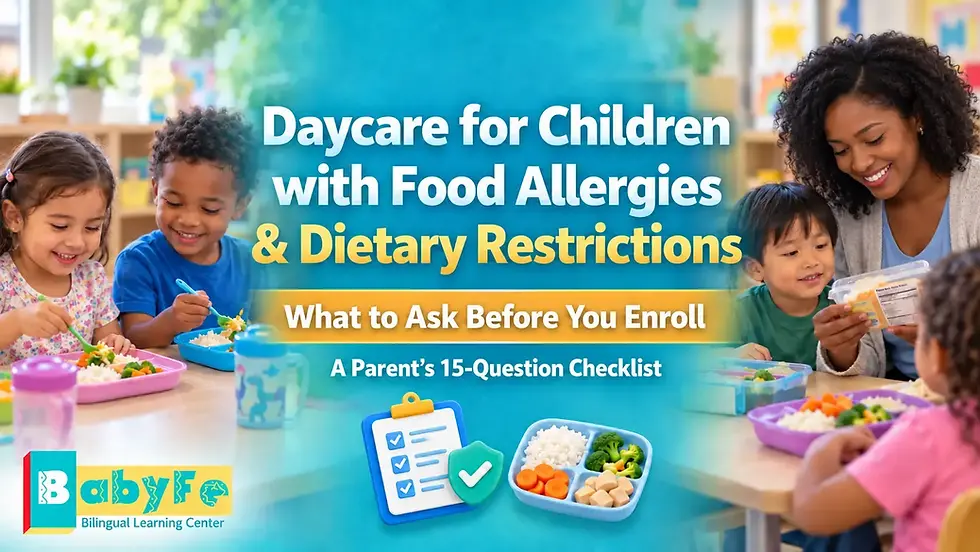
Food allergies and picky eating: Check out the daycare nutrition program and communicate any dietary restrictions clearly at enrollment, and keep information updated. Most preschools have clear allergy protocols. For picky eaters, a 'no pressure' snack environment where children can taste without being forced is ideal.
Supporting children with special needs: High-quality preschools are committed to inclusion. If your child has a developmental delay or has received an early intervention diagnosis, ask specifically about the program's experience with special needs support, IEP implementation, and collaboration with therapists.
How to Evaluate If Preschool Is Working for Your 2-Year-Old

So your child is enrolled and attending, but how do you actually know if it's working? Two-year-olds aren't exactly forthcoming with detailed progress reports! Here's how to evaluate whether your child's preschool experience is a positive and productive one.
Positive signs your child is thriving: They're generally happy to go to school (after the initial adjustment period). They talk about their teachers or friends. They come home with new words, songs, or skills. They engage in more complex play at home. They seem emotionally regulated and content.
Warning signs that something may be off: Persistent and intense distress every single morning after several weeks. Unusual regression in behavior (bedwetting, thumb-sucking, clingy behavior that gets worse, not better). Coming home hungry, hurt, or deeply upset regularly.
Understanding developmental assessments: Many preschool programs offer informal progress check-ins or developmental screenings. These are not grades; they're observations about where a child is in their development and where they could use more support. Embrace them as useful information, not judgment.
How to have a productive parent-teacher conference: Come prepared with observations from home. Share what you're noticing, both wonderful things and concerns. Ask specific questions. And listen with an open mind, teachers spend hours with your child and have a valuable perspective.
Knowing when to switch programs: If a program consistently fails to meet your child's basic safety, emotional, or developmental needs, and your concerns aren't being taken seriously, it may be time to look elsewhere. Trust your instincts. You know your child best.
Final Thoughts: Your Toddler's Big, Beautiful Beginning
Choosing and navigating preschool for 2-year-olds is one of the most meaningful decisions you'll make in your child's early years. And honestly? It doesn't have to be overwhelming. When you understand what healthy routines look like, what learning goals are age-appropriate, and which activities light up a toddler's brain, everything becomes a lot clearer.
Remember, at two years old, play IS learning. The best preschool programs understand this deeply, and the best thing you can do as a parent is stay curious, stay connected, and trust the process. Your child is growing in ways you can't always see, and every storytime, every sensory bin, every wobbly attempt at putting on their own shoes is building something remarkable.
Ready to take the next step? Start by touring two or three programs in your area with this guide in hand. Ask the hard questions. Observe how teachers interact with children. Watch how children interact with each other. And when you find the right place, that warm, buzzing, joyful little room, you'll know.
Your toddler deserves a strong, loving start. And with the right preschool, that's exactly what they'll get.


Comments