
Why Bilingual Daycare Matters: The Science Behind Spanish Immersion for Toddlers in 2026

As a parent, choosing the right childcare feels like one of the biggest decisions you’ll ever make. And if you’ve been eyeing a bilingual daycare or Spanish immersion program for your toddler, you’re probably wondering: Does it actually work? Is my child too young? Will they get confused?
I get it. Those questions kept me up at night, too.
The truth is, the science is overwhelmingly clear. Early childhood is a golden window for language acquisition, and Spanish-immersion daycare programs are uniquely positioned to capitalize on it. We’re not talking about flashcards and rote memorization; we’re talking about organic, play-based dual language learning that literally reshapes developing brains.
In this article, we’ll break down the neuroscience, bust the myths, and show you exactly why bilingual daycare isn’t just a nice-to-have. It’s one of the smartest investments you can make in your child’s future. If you’re still getting up to speed on what early childhood education really involves, that’s a great place to start.
The Critical Window — Why Toddler Brains Are Wired for Bilingualism
There’s a concept in linguistics called the “critical period hypothesis,” and it’s the reason neuroscientists get so excited about early language exposure. Between birth and roughly age five, the human brain is in an extraordinary state of plasticity. It’s forming new synaptic connections at a rate it will never match again, approximately one million new neural connections per second. This is the window when language isn’t learned. It’s absorbed.
Dr. Patricia Kuhl, a renowned neuroscientist at the University of Washington’s Institute for Learning and Brain Sciences, has spent decades studying how babies process language. Her research shows that infants are born as “citizens of the world,” and they can distinguish sounds from every language on Earth. But by their first birthday, this ability begins to narrow. The brain starts pruning phonetic categories it doesn’t hear regularly.
What does this mean for your toddler? It means that right now, their brain is primed to absorb Spanish (or any second language) with native-like proficiency. They’re not translating between languages the way adults do. They’re building two parallel language systems simultaneously, each with its own neural network. It’s effortless in a way it will never be again.
Waiting until elementary school, let alone high school, means working against the brain’s natural timeline. The critical window doesn’t slam shut overnight, but it does gradually close. And every month of immersion during these early years counts more than a year of study later on.
What Happens in the Brain During Spanish Immersion — The Neuroscience Explained
So what’s actually happening inside your toddler’s brain when they’re in a Spanish immersion environment? Quite a lot, as it turns out.
Neuroimaging studies using fMRI and EEG technology have revealed that bilingual children show increased gray matter density in regions associated with language processing, executive function, and memory. The brain isn’t just storing two languages; it’s getting a full cognitive workout every time a child switches between them.
One of the most significant findings involves executive function, the set of mental processes that includes attention control, working memory, and cognitive flexibility. When a bilingual toddler hears Spanish and English throughout the day, their brain is constantly managing which language to activate and which to suppress. This mental juggling act strengthens the prefrontal cortex, the same region responsible for problem-solving and self-regulation.
Think of it like cross-training for the brain. A monolingual child’s brain is doing a single exercise. A bilingual child’s brain is doing circuits. The result? Enhanced task-switching ability, better impulse control, and stronger working memory, skills that pay dividends in every area of life, not just language.
And here’s something remarkable: the cognitive benefits of early bilingualism appear to last a lifetime. Research published in the journal Neurology found that bilingual adults showed symptoms of dementia an average of 4.5 years later than monolingual adults. The cognitive reserve built during those early years creates a buffer that protects the brain well into old age.
Academic Advantages — How Bilingual Daycare Sets Toddlers Up for School Success

Parents often worry that introducing a second language will slow their child’s academic progress. The research says the opposite.
Multiple longitudinal studies have shown that children who attend bilingual or dual-language programs consistently outperform their monolingual peers on standardized tests, and not just in language arts. Bilingual students tend to score higher in math, reading comprehension, and critical thinking assessments by the time they reach third grade.
Why? A big part of the answer lies in something called metalinguistic awareness, the ability to think about language itself as a system. Children who grow up navigating two languages develop an intuitive understanding of grammar, syntax, and word structure that monolingual children simply don’t get as early. They understand that a “dog” in English and a “perro” in Spanish are just different labels for the same concept. This abstraction skill transfers directly to reading comprehension, mathematical reasoning, and scientific thinking.
A landmark study in the Journal of Educational Psychology followed dual-language learners from kindergarten through fifth grade and found that by third grade, bilingual students had not only caught up to their English-only peers in English literacy but had surpassed them. And they were literate in two languages.
Social and Emotional Benefits of Spanish Immersion for Young Children
The benefits of bilingual daycare extend far beyond test scores and cognitive metrics. Some of the most profound advantages are social and emotional.
Cultural Empathy: Children who grow up in bilingual environments develop cultural empathy at an early age. They’re exposed to different ways of expressing ideas, different cultural traditions, and different perspectives, all through the natural vehicle of language. This exposure cultivates an openness to diversity that’s increasingly valuable in our connected world.
Perspective-Taking: Research from the University of Chicago found that bilingual children are significantly better at perspective-taking, the ability to understand another person’s point of view. Because they’re accustomed to choosing the right language for the right listener, bilingual kids develop a heightened awareness of other people’s needs and communication styles. This makes them more empathetic, more socially adept, and better collaborators.
High Self-Esteem: There’s also the confidence factor. Toddlers who can communicate in two languages often show higher self-esteem and a stronger sense of identity. They know they possess a skill that not everyone has, and that knowledge carries real psychological weight, even at a young age.
Linguistic Sophistication: And let’s talk about code-switching, the natural practice of moving between languages within a single conversation. Far from being a sign of confusion, code-switching is actually a marker of linguistic sophistication. It shows that a child understands the social context of each language and can navigate between them fluidly. It’s emotional flexibility in action.
Debunking Common Myths About Bilingual Daycare
“It will confuse my child.”
This is the most persistent myth, and the research has thoroughly debunked it. Yes, bilingual toddlers sometimes mix languages in a single sentence; this is called code-mixing, and it’s a perfectly normal stage of bilingual development. It’s not confusion. It’s the brain efficiently drawing from all available resources. Studies show that by age three or four, bilingual children can reliably separate their two languages based on context and audience.
“My child will fall behind in English.”
Some bilingual children may appear to have a slightly smaller vocabulary in each language during the toddler years. But their total vocabulary across both languages is equal to or greater than that of monolingual children. By kindergarten or first grade, most bilingual children have caught up in English, and they have the added benefit of a second language.
“We don’t speak Spanish at home, so it won’t stick.”
Full immersion programs provide sufficient language exposure even without home reinforcement. While supporting Spanish at home through daily routines and simple phrases can certainly accelerate progress, it’s not a requirement for success. The daycare environment itself provides hours of rich, contextualized language input every day.
“Bilingual daycare is only for Hispanic families.”
The cognitive, social, and academic benefits of bilingualism are universal. They apply regardless of a family’s cultural background. Spanish happens to be the most widely taught second language in the U.S. and one of the most useful globally, making it an excellent choice for any family.
“Toddlers are too young for structured language learning.”
Here’s the thing: quality Spanish immersion programs aren’t “structured” in the way most people imagine. There are no desks. There are no grammar drills. The learning happens through play, songs, stories, and daily interactions, which is exactly how toddlers learn best.
What to Look for in a Quality Spanish Immersion Daycare Program
Not all bilingual programs are created equal. If you’re evaluating options for your toddler, here’s what separates a truly effective Spanish immersion daycare from one that’s bilingual in name only.
Native Or Highly Fluent Educators
The quality of language input matters enormously. Children need to hear natural, fluent Spanish, including the rhythm, intonation, and idiomatic expressions that only come from true fluency. Look for programs where the lead teachers are native speakers or have demonstrated advanced proficiency.
Clear Immersion Model
Programs typically follow one of two models: full immersion (100% Spanish during certain periods) or dual language (50/50 split). Both can be effective, but make sure the program has a clearly defined structure and isn’t just sprinkling in a few Spanish words here and there.
Play-Based Curriculum
For toddlers, the most effective language acquisition happens through play, not worksheets. Look for programs where Spanish is woven into art projects, outdoor play, music time, mealtimes, and circle time. The language should be everywhere, naturally.
Appropriate Student-To-Teacher Ratio
Language acquisition requires meaningful interaction, not just passive exposure. Lower ratios mean more one-on-one conversation time, which accelerates language development significantly.
Transparent Communication With Parents
A quality program will keep you informed about your child’s progress and give you tools to support their learning at home. Ask about newsletters, parent conferences, and suggested at-home activities.
If you’re looking for a program that checks all of these boxes, BabyFe Bilingual Learning Center is an excellent example of what a research-backed Spanish immersion daycare looks like in practice. Their approach combines native Spanish-speaking educators, play-based immersion, and strong parent communication.
Understanding the full cost of infant and toddler daycare can also help you budget for a high-quality bilingual program.
How to Support Your Toddler’s Bilingual Journey at Home
You don’t need to be fluent in Spanish to support your child’s bilingual development. Even small, consistent efforts at home can reinforce what they’re learning in daycare.
Music and songs. Spanish-language children’s music is one of the easiest tools to incorporate. Songs like “Los Pollitos” and “De Colores” are catchy, repetitive, and perfect for toddlers. Play them during car rides, bath time, or as part of your bedtime routine.
Books. Bilingual picture books let you read together in both languages. Even if your pronunciation isn’t perfect, the exposure to Spanish text and vocabulary builds literacy foundations. Your local library likely has a bilingual section worth exploring.
Daily routines. Integrating Spanish into daily routines and phrases is incredibly effective. Label common objects around the house in Spanish. Use simple phrases at mealtimes (“¿Quieres más?” — Do you want more?) or bedtime (“Buenas noches”). Consistency matters more than complexity.
Screen time with purpose. Shows like “Plaza Sésamo” (the Spanish Sesame Street) and apps designed for bilingual toddlers can supplement their learning. Keep screen time limited and interactive when possible.
Community connections. Seek out Spanish-language story times, playgroups, or cultural events in your area. Connecting with other bilingual families creates a community of support and gives your child more contexts in which to use their Spanish.
And remember: don’t put pressure on yourself or your child. Bilingual development isn’t linear. There will be phases where English dominates and phases where Spanish surprises you. Trust the process.
The Long-Term Payoff — Career, Cultural, and Cognitive Benefits That Last a Lifetime
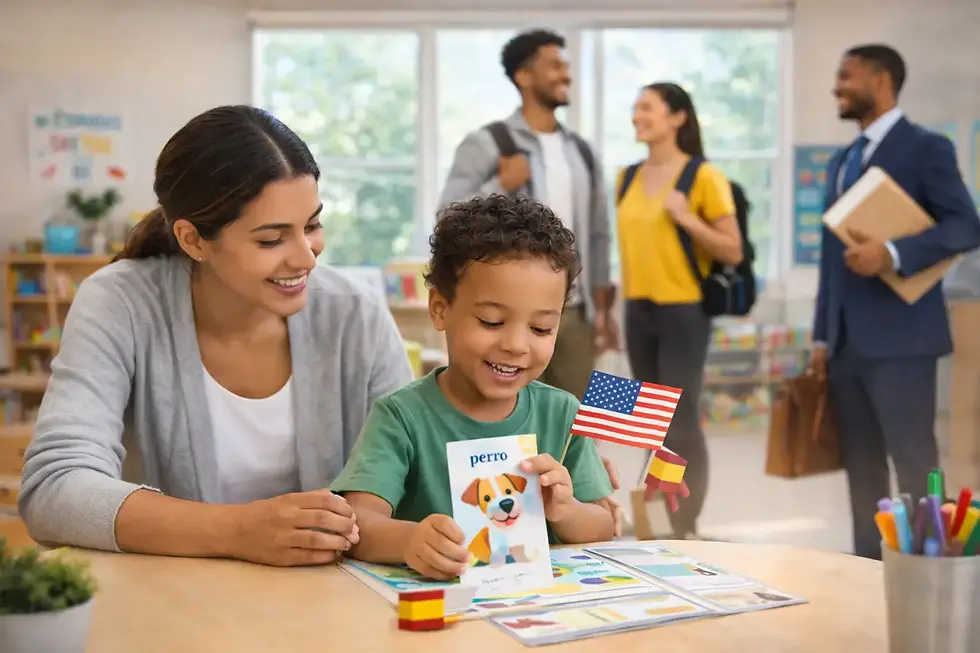
The investment you make in bilingual daycare today pays compound interest for decades.
From A Career Perspective
Bilingualism is increasingly a differentiator in the job market. The U.S. Bureau of Labor Statistics reports growing demand for bilingual professionals across healthcare, education, business, government, and technology. Spanish speakers in particular are in high demand, as Spanish is the second most spoken language in the United States and the fourth most spoken worldwide.
From A Cultural Perspective
Bilingualism opens doors that monolingualism simply cannot. Your child will be able to connect with over 500 million Spanish speakers globally. They’ll travel with more confidence, build deeper relationships across cultures, and access literature, art, and media in their original language.
From A Cognitive Perspective
The benefits compound over time. Bilingual adults consistently demonstrate greater cognitive flexibility, enhanced creativity, and superior problem-solving skills. And as mentioned earlier, the neuroprotective effects of bilingualism appear to delay cognitive decline in aging.
From the Linguistic Confidence Perspective
Perhaps the most powerful long-term benefit is linguistic confidence. Children who acquire a second language early find it dramatically easier to learn additional languages later in life. Your toddler isn’t just learning Spanish; they’re developing the neural architecture for lifelong multilingualism.
Conclusion: The Best Time to Start Is Now
So here’s the bottom line: bilingual daycare isn’t a trend. It’s not a luxury. It’s backed by decades of neuroscience, developmental psychology, and educational research. Spanish immersion for toddlers taps into a biological window that simply doesn’t stay open forever.
Your child’s brain is doing its most extraordinary work right now. Every song sung in Spanish, every story told, every playful interaction in a second language is building architecture that will serve them for the rest of their lives, academically, socially, and professionally.
You don’t need to speak Spanish fluently. You don’t need a perfect program. What you need is to start.
If you’re considering bilingual daycare for your toddler, take that next step. Tour a local Spanish immersion program. Ask questions. Talk to other parents. Check out programs like BabyFe Bilingual Learning Center to see what a science-backed immersion experience looks like. The research says you won’t regret it, and neither will your child.


Comments