
Understanding the Cost of Childcare: A Complete Guide for Parents (2026)

If you've recently searched "how much does daycare cost," you're probably still recovering from what you found. The numbers are real, and they're startling.
According to Child Care Aware of America, the national average annual price of childcare in 2025 is $13,184, up from $13,128 in 2024 and $11,582 in 2023. That's a $1,600 jump in just two years. Since 2021, childcare prices have risen 23%, nearly matching overall inflation over the same period.
In this guide, we're breaking down everything: average childcare expenses by age and type, the geographic factors that change the math completely, the financial tools most parents don't fully use, and how to evaluate whether a program's tuition is actually worth it. Whether you're expecting your first child or shopping for a toddler room, this is the guide you wish you'd had on day one.
Let's get into it.
What Is the Average Cost of Childcare in 2026?
Here's the honest answer: it depends. But let's start with the national benchmarks so you know what "average" actually looks like.
In 2026, the average cost of center-based infant care in the United States is $1,230 per month, or roughly $14,760 per year. For toddlers, the average drops to about $1,050/month ($12,600/year), and preschool-age care typically runs around $925/month ($11,100/year). Across all age groups, families can expect to pay somewhere between $13,000 and $15,000 annually for full-time center-based care.
Age Group | Average Monthly Cost | Average Annual Cost |
Infant (0–12 months) | $1,230 | $14,760 |
Toddler (1–3 years) | $1,050 | $12,600 |
Preschool (3–5 years) | $925 | $11,100 |
These numbers have risen 5–8% since 2024 and a staggering 23% since 2021. And here's what makes it even more complex: the average parent in 2026 is managing not just one care arrangement, but an average of four, including care for older children, aging relatives, and other household needs. The full burden is bigger than any single price tag suggests.
The national average is a useful starting point, but it can be misleading. Where you live, your child's age, and the type of care you choose will all push that number significantly higher or lower. Keep reading; the details matter.
Why Infant Care Costs More Than Toddler or Preschool Care
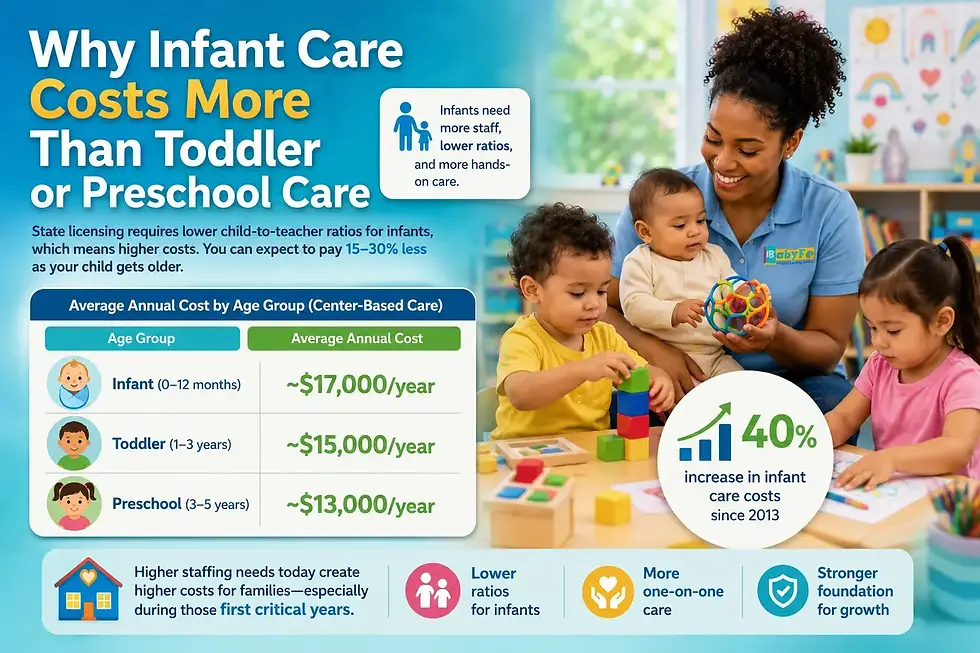
One of the most consistent patterns in childcare pricing: infants cost significantly more to care for than older children. The reason is staffing. State licensing regulations require lower child-to-teacher ratios for infants, meaning providers need more staff per child. As a result, you can expect to pay 15–30% less as your child gets older and moves out of the infant room.
Here's how the national averages break down by age group for center-based care:
Age Group | Average Annual Cost |
Infant (0–12 months) | ~$17,000/year |
Toddler (1–3 years) | ~$15,000/year |
Preschool (3–5 years) | ~$13,000/year |
Infant care costs have risen 40% since 2013, a trend that's squeezing families hardest in those first critical years.
How Much Does Childcare Cost by Location?
Geography is one of the biggest cost drivers. Urban areas and states with high costs of living, Massachusetts, California, New York, and Washington, D.C., consistently top the charts.
Washington, D.C., has the most expensive childcare in the country at $24,243 per year, or roughly $2,020 per month, comparable to a one-bedroom apartment's monthly rent in many cities.
Massachusetts comes in second at $20,913 annually.
Mississippi is the most affordable state, with infant care running around $5,436–$6,868 per year.
As a rule of thumb, childcare is typically more affordable in the Midwest and more expensive on the coasts. But even within states, costs vary dramatically between urban, suburban, and rural areas. Urban center-based infant care can run $1,800–$2,500 per month, while suburban families may pay $1,400–$1,900 and rural families closer to $800–$1,200. Read our reviews from BabyFe families to hear directly from parents navigating these exact decisions.
Childcare Cost by Type of Care
Not all childcare is the same, and the type of arrangement you choose has a major impact on cost.
Center-Based Daycare
The most common type for families with infants and toddlers. Large commercial franchise centers typically charge 30–50% more than independent family childcare homes due to higher overhead and corporate margins. The national average monthly cost for center-based infant care is $1,230/month.
If you're comparing programs, be sure to ask about curriculum philosophy, not just tuition. A program grounded in learning through play or structured bilingual education can offer developmental value well beyond what the price tag alone communicates.
Family Childcare Homes
A licensed provider caring for a small group of children in their home. Generally less expensive than a center, with more flexible hours and a home-like environment.
Nannies and Au Pairs
The most expensive option on average. Nationally, the average annual cost to hire a nanny is $42,432/year, with California being the priciest state at $51,813/year. Nannies typically cost 65–135% more per year than center-based daycare, depending on the state, but for families with multiple children or irregular schedules, the math can sometimes work in their favor.
Before and After School Care
For school-age children, structured programs through schools or community centers typically run:
Public school extended day programs: $150–$400/month
Childcare center after-school programs: $300–$700/month
Community/recreation center programs: $160–$500/month
Part-Time vs. Full-Time
Part-time slots lower the monthly bill but aren't always available; centers typically fill full-time spaces first.
And when you're ready to visit a program, don't forget to bring your first day daycare checklist; the logistics of enrollment day are easier when you've prepared.
The Real Financial Weight on Families
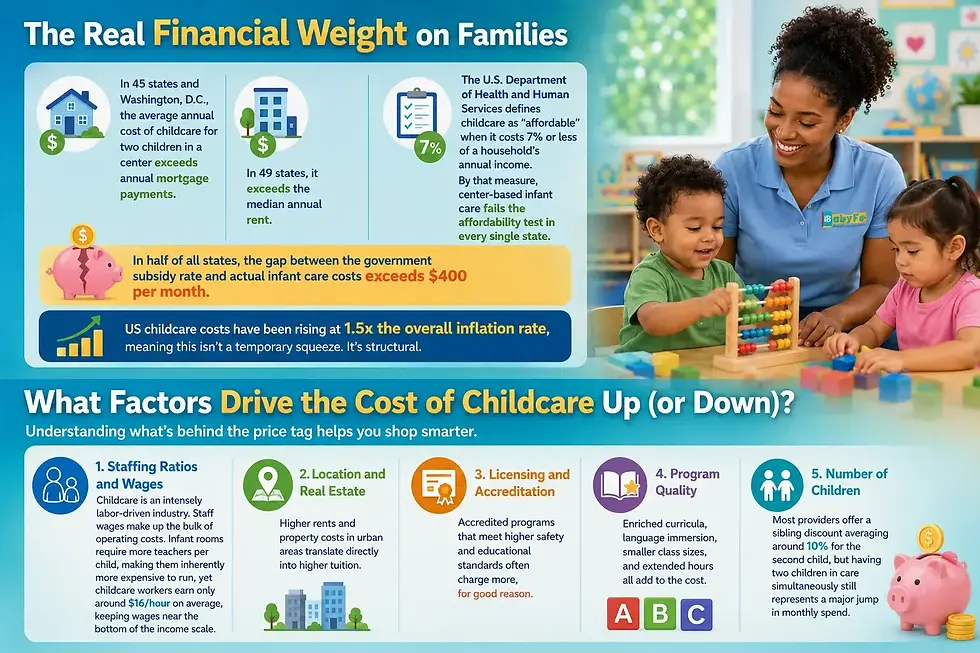
To put these numbers in context: in 45 states and Washington, D.C., the average annual cost of childcare for two children in a center exceeds annual mortgage payments. In 49 states, it exceeds the median annual rent.
The U.S. Department of Health and Human Services defines childcare as "affordable" when it costs 7% or less of a household's annual income. By that measure, center-based infant care fails the affordability test in every single state. In half of all states, the gap between the government subsidy rate and actual infant care costs exceeds $400 per month.
US childcare costs have been rising at 1.5x the overall inflation rate, meaning this isn't a temporary squeeze. It's structural.
What Factors Drive the Cost of Childcare Up (or Down)?
Understanding what's behind the price tag helps you shop smarter.
Staffing ratios and wages. Childcare is an intensely labor-driven industry. Staff wages make up the bulk of operating costs. Infant rooms require more teachers per child, making them inherently more expensive to run, yet childcare workers earn only around $16/hour on average, keeping wages near the bottom of the income scale.
Location and real estate. Higher rents and property costs in urban areas translate directly into higher tuition.
Licensing and accreditation. Accredited programs that meet higher safety and educational standards often charge more, for good reason.
Program quality. Enriched curricula, language immersion, smaller class sizes, and extended hours all add to the cost.
Number of children. Most providers offer a sibling discount averaging around 10% for the second child, but having two children in care simultaneously still represents a major jump in monthly spend.
Is the Cost of Childcare Worth It? Understanding the Value
Let's zoom out from the numbers for a moment. Because this question, Is it worth it? is one every parent quietly asks.
The answer from research is unambiguous: quality early childhood education is one of the highest-return investments a family can make. Studies consistently link high-quality care in the 0–5 years to improved school readiness, stronger social-emotional development, better language acquisition, and measurable long-term outcomes in education, health, and earnings. The brain develops faster in the first five years than at any other time in life. What happens during those years matters enormously.
For families considering bilingual or language immersion programs, the value compounds further. Early childhood education in a dual-language environment doesn't just teach Spanish; it rewires how children process language, problem-solve, and think.
When evaluating whether a program's cost is justified, ask:
Is it licensed and accredited? (NAEYC is the gold standard)
What are the child-to-teacher ratios, and do they exceed legal minimums?
What is teacher turnover like? High turnover is a red flag for quality and stability
Does the curriculum reflect a clear developmental philosophy?
How does the program support motor development, social skills, and language? (See our deep dives on motor skills development)
How does the center communicate with parents, and how often?
How to Reduce Your Childcare Costs: Financial Tools Available to Parents
The costs are real, but so are the tools to offset them.
1. Child and Dependent Care Tax Credit (CDCTC)
This federal tax credit allows working parents to claim a percentage of qualifying childcare expenses. You can claim up to $3,000 for one child or $6,000 for two or more children, with the credit ranging from 20% to 35% of eligible expenses based on your adjusted gross income (AGI). Starting with the 2026 tax year, the "One Big Beautiful Bill Act" (OBBBA) increases the top credit rate to 50% for qualifying households.
A tax credit is more valuable than a deduction; it reduces your actual tax bill dollar-for-dollar, not just your taxable income.
2. Dependent Care Flexible Spending Account (DC-FSA)
If your employer offers a dependent care FSA, take full advantage. You set aside pre-tax dollars, reducing both income and payroll taxes, to pay for eligible care expenses, including daycare, preschool, after-school programs, and summer day camps.
Beginning in 2026, the OBBBA increases the maximum contribution from $5,000 to $7,500 per year (or $3,750 if married filing separately). That's potentially hundreds of dollars in tax savings, depending on your bracket.
Important note: FSA contributions and the CDCTC interact. You cannot use the same dollar of expense to claim both benefits; FSA contributions reduce the amount you can claim for the tax credit.
3. Child Care Subsidies and State Assistance
Federal and state subsidy programs (often administered through the Child Care and Development Fund, or CCDF) assist low- and moderate-income families. Eligibility, benefit amounts, and waitlists vary significantly by state. Visit childcare.gov to find financial assistance options in your area.
4. Employer-Sponsored Benefits
Some employers offer childcare benefits beyond the FSA, including backup childcare services, partnerships with local centers, or direct childcare subsidies. It's worth asking HR what's available, especially as employers become more attentive to childcare as a retention issue.
5. Sibling Discounts and Enrollment Timing
Ask every center you tour about sibling pricing; the national average discount is 10%, but many providers offer more. Enrolling early (particularly for infants) also matters: waitlists at quality programs can stretch 12–18 months in competitive markets.
If you're preparing to visit programs, don't walk in without a game plan. Our guide on questions to ask on a daycare tour gives you a complete list of what to ask, what to observe, and what the answers should tell you.
What Does Quality Childcare Give You in Return?

It's worth remembering what the cost buys. Quality early childhood education, particularly for ages from birth through 5, has some of the strongest returns on investment of any educational spending. Research consistently links high-quality early care to improved school readiness, social-emotional development, and long-term outcomes in health, education, and earnings.
Programs that invest in low child-to-teacher ratios, trained educators, enriched environments, and language-rich curricula cost more for a reason. When evaluating programs, look for:
Licensing and accreditation status (NAEYC accreditation is the gold standard)
Teacher qualifications and turnover rates
Child-to-teacher ratios (lower is better, especially for infants)
Curriculum and developmental philosophy
Communication practices with parents
Safety procedures and facility cleanliness
Key Takeaways
Childcare costs in 2026 are high, averaging over $13,000 per year nationally, with infant care pushing considerably higher in most metro areas. But understanding the full picture puts you in a much better position:
Costs vary dramatically by age, type of care, and location
Infants are always the most expensive age group to enroll
Tax credits and FSA contributions can meaningfully reduce your out-of-pocket spend
Subsidies and employer benefits may be available depending on your income and employer
Quality matters, the right program is an investment in your child's development
If you're in the early stages of exploring childcare, the most important first step is to start the search early, ask the right questions, and understand all the financial tools available to you.



Comments