
The Ultimate First Day Daycare Checklist: Everything You Need to Pack in 2026

Did you know that nearly 59% children under age 5 attend some form of childcare in the United States every year? That's a whole lot of diaper bags, labeled bottles, and teary drop-offs happening across the country every single morning. And if you're reading this right now, you're probably about to join that club!
I remember standing at the daycare door on my child's first day, completely convinced I had forgotten something critical. Had I packed enough diapers? Did I label the bottles? Where on earth did I put the emergency contact form? It's a lot. And the emotional weight of leaving your baby with someone new for the first time makes it even harder to think clearly.
That's exactly why a solid first day daycare checklist isn't just helpful, it's essential. This guide walks you through absolutely everything you need to pack, what to label, what to leave at home, and how to set yourself and your baby up for the smoothest possible start. Let's do this!
Why a First Day Daycare Checklist Is Your Best Friend
Let's be honest, the first day of daycare is emotionally chaotic. You're likely running on nerves, a fragile amount of sleep, and the nagging feeling that you've forgotten something. And when you're in that headspace, improvising is the last thing you want to do.
A detailed daycare packing list takes the guesswork out of the morning rush. Instead of scrambling through the nursery at 7 a.m., you've already thought. Everything is packed, labeled, and ready to go the night before. That single act of preparation can transform drop-off from a stressful sprint into a calm, confident moment, and that energy absolutely transfers to your baby.
STAT: 68% of parents say the first week of daycare is the most stressful childcare transition they face, ChildCare Aware of America, 2024 |
If you're still in the research phase, you might also want to check out our full breakdown of infant daycare costs in 2026. Understanding what you're paying for helps set expectations before day one.
Daycare providers will also tell you that prepared parents make their jobs easier. When they receive a well-stocked bag with clearly labeled items and a written routine, they can focus entirely on your baby's comfort and care, rather than hunting down unlabeled bottles or guessing at feeding schedules.
This first-day daycare checklist covers every category: diapering, feeding, clothing, sleep, health, and more. Use it the night before your baby's first drop-off, and you'll walk through that daycare door feeling like the organized, loving parent you absolutely are.
Diapering Essentials: Don't Leave Home Without These
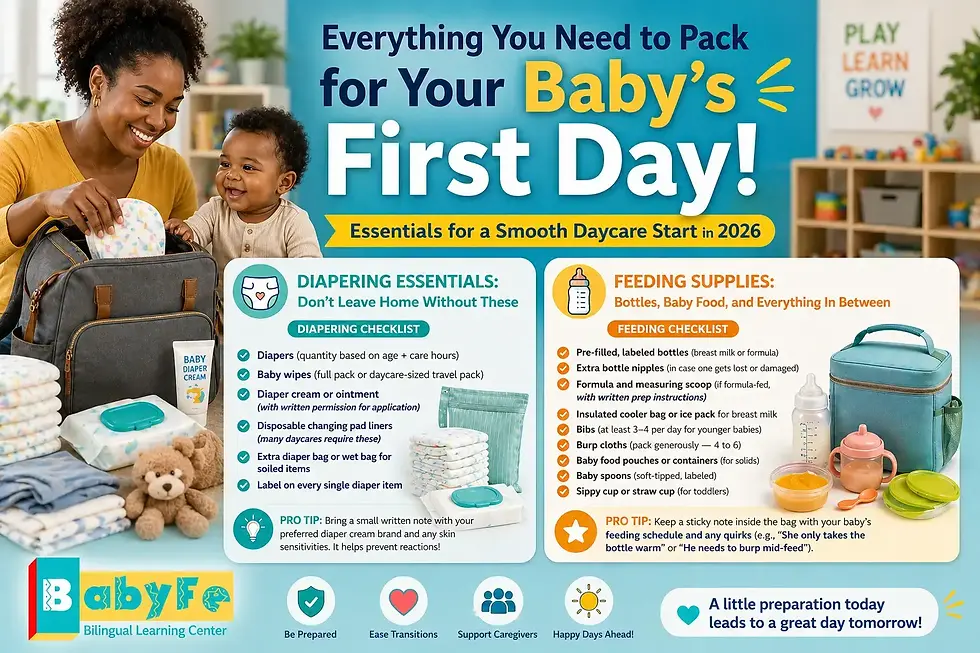
Diapers seem obvious, but there's more nuance here than most first-time daycare parents expect. The quantity, type, and labeling of your diapering supplies all matter, and getting them wrong can mean your baby's bag gets mixed up with another child's, or worse, runs out before pickup.
How Many Diapers Should You Pack?
A good rule of thumb is one diaper per hour of care, plus two extras. For a full 8-hour daycare day, that's roughly 10 diapers for a newborn, 6–8 for a 6-month-old, and 4–6 for a toddler. Newborns and young infants go through far more diapers than you might expect in a daycare setting because caregivers change them on a strict schedule to prevent rashes.
✓ Diapering Checklist |
✓ Diapers (quantity based on age + care hours) |
✓ Baby wipes (full pack or daycare-sized travel pack) |
✓ Diaper cream or ointment (with written permission for application) |
✓ Disposable changing pad liners (many daycares require these) |
✓ Extra diaper bag or wet bag for soiled items |
✓ Label on every single diaper item |
If you use cloth diapers, check your daycare's policy before the first day. Many daycares do accommodate cloth, but they'll need a waterproof wet bag for soiled diapers and may have specific requirements around inserts or covers.
Pro Tip: Bring a small written note with your preferred diaper cream brand and any skin sensitivities your baby has. Caregivers appreciate the detail, and it prevents well-meaning substitutions that could cause a reaction. |
Feeding Supplies: Bottles, Baby Food, and Everything In Between
Feeding logistics are where the daycare packing list gets most complicated, especially for breastfeeding moms. The good news? Once you have a system down, it becomes second nature. Here's what you need to think through before day one.
Bottles and Breast Milk
Most daycares recommend sending one bottle per feeding, plus one extra. If your baby feeds every 2–3 hours, that's typically 3–4 bottles for a full day. Label each bottle with your baby's full name and the date the milk was pumped. Most centers follow the CDC's breast milk storage guidelines and will discard anything unlabeled, so don't skip this step!
✓ Feeding Checklist |
✓ Pre-filled, labeled bottles (breast milk or formula) |
✓ Extra bottle nipples (in case one gets lost or damaged) |
✓ Formula and measuring scoop (if formula-fed, with written prep instructions) |
✓ Insulated cooler bag or ice pack for breast milk transport |
✓ Bibs (at least 3–4 per day for younger babies) |
✓ Burp cloths (pack generously — 4 to 6) |
✓ Baby food pouches or containers (for babies starting solids) |
✓ Baby spoons (soft-tipped, labeled) |
✓ Sippy cup or straw cup (for toddlers) |
Starting Solids? Here's what to pack.
For babies between 6 and 12 months who are beginning solid foods, send pre-portioned containers of purees or soft foods along with a note about any foods your baby has already tried and any allergies. Most daycares will not introduce a new food; that's a job for home. They'll only serve foods your baby has already had safely.
Pro Tip: Keep a sticky note inside the bag with your baby's feeding schedule and any quirks ('She only takes the bottle warm' or 'He needs to burp mid-feed'). Your caregiver will love you for it. |
Wondering what your baby will actually eat once they start solids at daycare? Our guide to daycare nutrition covers how quality centers plan meals, handle allergies, and support healthy eating habits from the very first bite.
Clothing and Comfort: Pack More Than You Think You'll Need
If there is one universal daycare truth, it is this: your baby will need more outfit changes than you expect. Spit-up, diaper blowouts, messy meals, mud puddles on the playground, daycare life is wonderfully messy. Pack accordingly!
How Many Outfits Per Day?
The industry-standard recommendation is 2–3 complete outfit changes per day for infants, and at least 2 for toddlers. 'Complete' means top, bottom, onesie, and socks. Don't forget socks; they go missing constantly.
✓ Clothing Checklist |
✓ 2–3 full outfits (seasonally appropriate) |
✓ 3–4 pairs of socks (they disappear, pack extra!) |
✓ Shoes (required for walking babies and toddlers) |
✓ Lightweight jacket or cardigan (for indoor AC or outdoor changes) |
✓ Hat for sun protection during outdoor play |
✓ Sleep sack or wearable blanket for nap time |
✓ Waterproof pants or rain gear (for toddlers in wet climates) |
✓ Wet bag for soiled clothing to come home in |
Choose clothing that's easy for caregivers to change, elastic waistbands, snaps at the crotch for infants, and nothing with complicated buttons or belts. The simpler, the better. And label everything. Every. Single. Item.
Tip: Seasonal note: If you're starting daycare in winter, layer your baby's clothing so caregivers can easily adjust for indoor and outdoor temperatures. A zip-up fleece over a onesie is much easier to manage than a heavy snowsuit in a busy daycare room. |
Note: Outdoor play isn't just about fresh air; it's one of the most powerful drivers of your baby's physical growth. Our motor skills development guide for ages 0–5 explains exactly what to expect and how to support it at every stage.
Sleep and Nap Time Must-Haves
Nap time at daycare is sacred, and most centers have very specific requirements about what goes in and around your baby's sleep space. Understanding these policies before day one prevents the awkward moment where a caregiver has to return your lovingly packed sleep items at drop-off.
What Most Daycares Require for Sleep
The majority of licensed childcare centers follow the AAP Safe Sleep Guidelines, which means a firm, flat surface, no loose bedding, and no sleep positioners. Many daycares provide their own cribs or pack-n-plays, but require parents to supply fitted sheets that meet their crib dimensions.
✓ Nap Time Checklist |
✓ 2 fitted crib or pack-n-play sheets (keep one as a backup) |
✓ Sleep sack or wearable blanket (in place of loose blankets) |
✓ Pacifier (if your baby uses one, label it!) |
✓ Small comfort item or lovey (check your daycare's policy first) |
✓ Written nap schedule with typical sleep cues |
Pro Tip: Send your baby's nap schedule in writing on the first day. Include typical sleep cues ('rubs eyes and pulls at ears'), how long naps usually last, and whether white noise helps. This information is gold for caregivers getting to know your baby. |
Health, Safety, and Medical Essentials
This section is one that most parents overlook until they get a call from daycare asking where the medication authorization form is. Don't let paperwork be the thing that derails an otherwise smooth first day!
Medication and Allergy Documentation
If your baby requires any medication, even over-the-counter items like infant Tylenol or teething gel, you will need to provide it in the original labeled packaging along with a signed medication authorization form. Most daycares cannot administer any medication without one, period.
✓ Health & Safety Checklist |
✓ Signed medication authorization form (if applicable) |
✓ Prescribed medications in original, labeled packaging |
✓ Written allergy action plan (for any known food or environmental allergies) |
✓ Emergency contact list (beyond what's in the enrollment forms) |
✓ Up-to-date immunization records (most centers require these on file) |
✓ Sunscreen (SPF 30+, labeled — check your daycare's application policy) |
✓ Insect repellent (if required by your center for outdoor play) |
Important: Never pack sunscreen or insect repellent without checking your daycare's policy first. Some facilities prohibit certain formulations due to allergies among other children in the classroom. |
Labeling Everything: The Non-Negotiable Step Most Parents Skip

I cannot stress this enough: Label everything. Bottles, sippy cups, pacifiers, clothing items, shoes, comfort objects, diaper cream, sunscreen, sleep sacks, sheet sets, all of it. If it leaves your house and goes to daycare, it needs your child's full name on it.
Daycare classrooms are busy, high-turnover environments where identical bottles and tiny socks pile up constantly. Without clear labels, things get mixed up, lost, or, most painfully, tossed out because no one can identify the owner.
Best Labeling Methods for Daycare
✓ Labeling Options Compared |
✓ Write-on labels (waterproof): Best for bottles, sippy cups, and containers. Fast and dishwasher-safe. |
✓ Iron-on clothing labels: Excellent for onesies, sleep sacks, and jackets. Survive many wash cycles. |
✓ Sticky name labels: Great for diaper cream, sunscreen tubes, and bags. Look for dishwasher-safe versions. |
✓ Permanent marker: Quick backup option for tags, but fades faster than dedicated labels. |
✓ Name stamp kits: A popular investment for organized families, one stamp that works on fabric, paper, and plastic. |
Pro Tip: Label the night before, not the morning of. You don't want to be hunting for a Sharpie at 6:45 a.m. while your baby is crying and your coffee is getting cold. |
What to Leave at Home: Items Daycares Typically Don't Allow
Just as important as knowing what to pack is knowing what not to send. Most licensed daycare centers have strict policies about items from home, and for good reason.
✗ Do NOT Pack These |
✓ Toys from home (choking hazards, sharing conflicts, and loss potential) |
✓ Tablets, phones, or any screen-based devices |
✓ Hard plastic toys with small parts (choking risk for other children) |
✓ Jewelry, including teething necklaces (strangulation and choking risk) |
✓ Food containing top allergens without prior approval (nuts, eggs, dairy) |
✓ Any medication not in the original packaging with your child's name |
✓ Loose change or small objects in bag pockets |
The reason daycares discourage toys from home goes beyond safety. When a child brings a special toy, it can cause significant distress when another child wants to hold it, and caregivers can't always mediate ownership disputes among infants and toddlers fairly.
The good news? Your baby doesn't need toys from home to thrive; quality daycare environments are designed to stimulate growth through everything in the room. Our article on learning through play explains exactly how children build critical skills through structured and free play at daycare.
Tip: Check your specific daycare's policy list. Some centers are more flexible than others, especially for older toddlers. What's prohibited at one facility may be fine at another. When in doubt, ask before packing. |
Tips for a Smooth First Day Drop-Off
You've packed everything. You've labeled everything. The bag is by the door. Now comes the hardest part: actually leaving.
Drop-off is emotionally charged, for you, potentially for your baby, and sometimes even for your caregiver, who is watching a new family navigate this milestone for the first time. Here's how to make it as smooth as possible.
Note: Still searching for the right fit? Our guide to the best daycare in the DC Metro Area walks through exactly what to look for, from caregiver ratios to how centers communicate with parents day to day.
Establish a Consistent Drop-off Routine from Day One
Babies and toddlers thrive on predictability. Even on the very first day, establish a short, consistent goodbye ritual. It could be a hug, a kiss, a specific phrase ('I love you, I'll be back after nap!'), and then you hand them to the caregiver and leave. The same sequence, every single day. Over time, this ritual becomes a powerful signal to your child that drop-off is safe and predictable, even if they cry at first.
Don't Linger
This is counterintuitive, but lingering at drop-off almost always makes things harder for both of you. A prolonged goodbye stretches out the anxiety and sends the signal that there's something to be worried about. Say your goodbyes warmly and confidently, then go. Most babies stop crying within minutes of their parents leaving.
Communicate your Baby's Daily Routine
On the first day, especially, give your caregiver a written summary of your baby's typical daily schedule. Include wake time, nap windows, feeding times, fussiness patterns, and any specific soothing strategies that work.
✓ First Day Drop-Off Checklist |
✓ Written daily routine for your baby (naps, feeds, moods) |
✓ Updated emergency contact list |
✓ Quick note about any changes since enrollment |
✓ Goodbye ritual planned and ready to execute |
✓ Your phone fully charged (so you're reachable all day) |
✓ Permission yourself to feel emotional, it's completely normal |
Managing Your Own Separation Anxiety

Here's something no one tells you: parent separation anxiety is just as real as the baby's. You may feel teary, distracted, or guilty all morning, and that's completely valid. Allow yourself to feel it. Text a friend, call a family member, or go get that coffee. It gets easier. Usually by the end of week two.
Final Thoughts: You've Got This!
The first day of daycare is a big milestone, for your baby, yes, but also for you. It marks a new chapter of independence, trust, and growth for your whole family. And while it can feel overwhelming in the lead-up, a thorough first-day daycare checklist genuinely takes so much of that weight off your shoulders.
Let's recap what you need to nail it:
✓ Your Complete First Day Daycare Checklist |
✓ Diapers, wipes, and diaper cream (labeled) |
✓ Bottles, formula or breast milk, feeding supplies (all labeled) |
✓ 2–3 complete outfit changes + socks and shoes |
✓ Sleep sack, fitted crib sheet, and comfort items (policy-checked) |
✓ Sunscreen, medication forms, and allergy action plan |
✓ Every item labeled with your child's full name |
✓ Written daily routine for caregivers |
✓ Your goodbye ritual, ready to go |
Pack the night before. Label everything twice if you have to. Write that routine note. And when you walk out that daycare door, know that your baby is in capable, caring hands, and that you did everything right.
Have something to add to this list? A labeling hack you swear by, or a first-day lesson you learned the hard way? Drop it in the comments, we love hearing from real daycare parents who've been through it. And if this guide helped you, share it with a parent-to-be who needs it. We're all in this together!


Comments