
How to Choose an Infant Daycare in Alexandria, VA: A Room-by-Room Tour Checklist (2026)
- BabyFe

- May 6
- 12 min read
I still remember standing in the doorway of the first daycare I ever toured, baby on my hip, checklist nowhere in my brain, completely overwhelmed. Nobody tells you how hard it is to evaluate a place in 45 minutes when your heart is doing most of the thinking.
Here's the truth: most Alexandria parents tour two or three infant daycares before making a decision. But without knowing how to choose an Infant Daycare in Alexandria, what to look for, every place starts to look the same. The smiling staff, the clean floors, the colorful walls- they can all blur together when you're running on no sleep and a lot of love.
That's exactly why I put this guide together. Whether you're just starting your search or you've already done a few tours and still feel unsure, this room-by-room checklist will give you a clear, confident framework for choosing the right infant daycare in Alexandria, VA, for your baby. Let's walk through it together.
How to Choose an Infant Daycare in Alexandria — Start with These Phone Questions
To decide how to choose an Infant Daycare in Alexandria, here's something most parents skip: the pre-tour phone call. It takes 10 minutes, and it can save you a wasted afternoon. Before you load the baby into the car and drive across town, ask these questions.
First, do they actually have availability for your baby's age group right now? Infant slots in Alexandria fill up fast. Some centers have waitlists that stretch six months or longer. Don't fall in love with a place that can't take your baby until they're walking.
Next, ask about their caregiver-to-infant ratio. Virginia's licensing standards set a baseline, but the best infant daycare programs in Alexandria go beyond what's required by law. A ratio of 1:3 or 1:4 is what you want to hear. Anything higher than 1:5 for very young infants deserves further questioning.
Not sure how to compare your options? Our guide on the best daycares in Alexandria breaks down what separates truly exceptional programs from average ones — a helpful read before your first phone call.
Key questions to ask over the phone:
Are you currently licensed, and when was your last state inspection?
What is your caregiver-to-infant ratio in the infant room?
Do you follow individual baby schedules or a group timetable?
Do you have availability for my baby's age group?
Are all staff in the infant room CPR and first aid certified?
What is your policy if a baby is sick or has a fever?
If a center hesitates or gets defensive answering any of these, especially the licensing question, that tells you something important before you've even walked through the door.
Choosing an Infant Daycare in Alexandria: What to Observe the Moment You Walk In
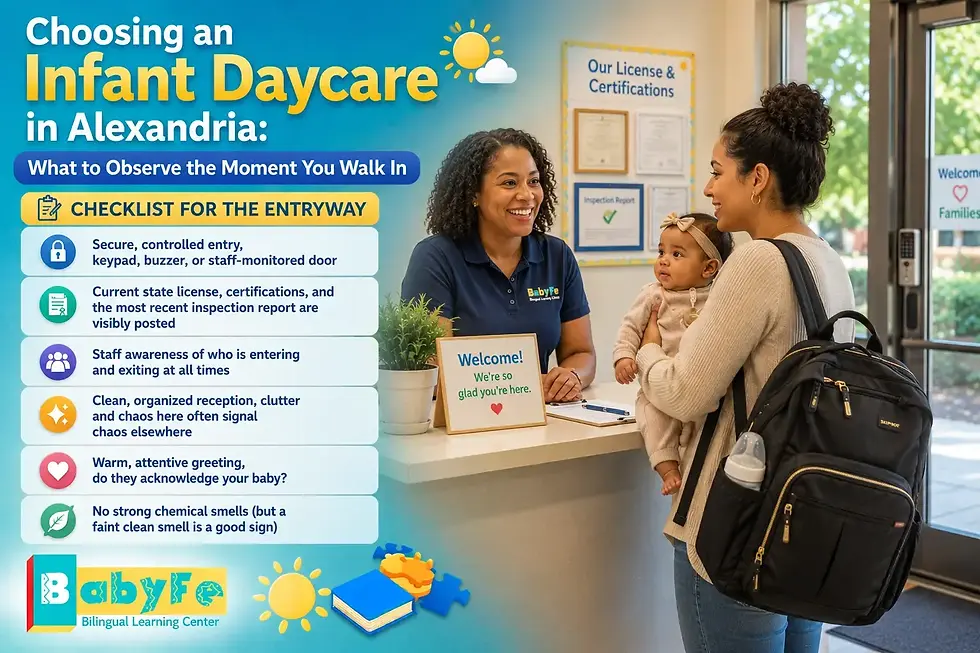
Your first impression matters. Not just aesthetically, functionally. The entryway of an infant daycare tells you a lot about how seriously they take security, organization, and culture.
Does the entry require a keypad code, buzzer, or staff release to get inside? A propped-open door, even briefly, is a red flag. The best centers in Alexandria treat secure entry as non-negotiable, not an afterthought.
Pay attention to how you're greeted. Is there warmth? Does someone make eye contact and acknowledge you and your baby? The energy of a front desk reflects the culture of the whole building. Cold, transactional, or distracted reception staff? That's something to note.
Checklist for the entryway:
Secure, controlled entry, keypad, buzzer, or staff-monitored door
Current state license, certifications, and the most recent inspection report are visibly posted
Staff awareness of who is entering and exiting at all times
Clean, organized reception, clutter and chaos here often signal chaos elsewhere
Warm, attentive greeting, do they acknowledge your baby?
No strong chemical smells (but a faint clean smell is a good sign)
Think of the entryway as the cover of the book. It's not the whole story, but it gives you real information.
The Infant Room — The Most Important Space in the Building
This is the room. Everything else on the tour is context; this is where your baby will spend their days. Take your time in here. Look slowly. Ask questions. Notice everything.
The first thing to assess is whether this room was actually designed for infants, or whether it's a repurposed toddler space with some baby toys thrown in. Infant-specific rooms feel different. They're calmer, lower to the ground, with soft lighting and sensory elements. If it feels chaotic or oversized for very young babies, trust that instinct.
Look at the sleep area carefully. Cribs should have firm, flat mattresses. No loose blankets, stuffed animals, or positioning devices, ever. Safe sleep standards exist for a reason, and a quality infant room will follow them visibly and consistently, not just when inspectors visit.
The diapering station is another tell. It should have a posted sanitation protocol, and you should see evidence that it's actually being followed: a fresh liner for each change, hand sanitizer or a handwashing sink within arm's reach, and a clearly organized system.
Wondering what to pack on enrollment day? Our first day at daycare checklist covers everything you'll need to bring, from labeled bottles to comfort items, so your baby's first morning goes as smoothly as possible.
Infant room checklist:
Age-appropriate design, calm, low-stimulation, built for babies, not toddlers
Soft lighting and sensory-friendly environment
Safe sleep compliance: firm mattresses, no loose bedding in cribs
Dedicated tummy time and floor play area, clean, padded, age-appropriate
Babies are being held, spoken to, and engaged, not left in bouncers
Diapering station with posted sanitation protocol and visible hygiene practices
Comfortable room temperature, not too hot, not too cold
Materials and toys are clean, sanitized, and developmentally appropriate
Most importantly: How do the babies in the room seem? Content, engaged, and settled is what you want to see. Distressed, unattended, or visibly overstimulated babies tell you something about the quality of care, regardless of how nice the furniture looks.
Watching the Caregivers in Action — The Most Telling Part of Any Tour

You can evaluate a facility. You can check boxes about square footage and sanitation. But you cannot fake what it looks like when a caregiver genuinely loves the babies in their care, and you also cannot hide when they don't.
Watch what caregivers are doing during your tour. Are they actively engaging with babies, talking to them, narrating what they're doing, making eye contact, responding quickly to fussing? Or are they managing tasks while the babies sit in their swings? The difference is enormous.
If you're wondering what early childhood training actually involves and why it matters, our post on early childhood education explained is a great primer. Understanding the difference between a trained child development professional and a general childcare worker completely changes how you evaluate a center's staff.
Ask about staff tenure. High turnover in an infant room is one of the biggest red flags you can find. Infants bond with consistent caregivers; that consistency is part of what makes quality infant care developmentally valuable. A center where staff rotate frequently or seem new disrupts the bond repeatedly.
Caregiver checklist:
Actively engaging with babies, talking, singing, and making eye contact
Warm, unhurried body language, not task-focused or distracted
CPR and first aid certified (ask to verify, not just confirm)
Trained in early childhood development, not just general childcare
Low turnover; ask how long the infant room staff have been there
Your baby will have a consistent primary caregiver, not a rotating cast
Caregivers respond quickly and calmly when a baby cries
Here's a simple test: during the tour, watch whether caregivers acknowledge your baby, making faces, saying hello, reacting to them naturally. People who love babies can't help themselves. That instinct is what you want to care for your child every day.
The Feeding and Sleep Area — Routines That Respect Your Baby
For very young infants, feeding and sleep aren't just needs; they're the architecture of their entire day. How a daycare handles these two things says everything about their caregiving philosophy.
If you're a nursing mom, breastmilk handling is critical. Ask exactly how milk is stored, how it's labeled to prevent mix-ups, and how it's warmed. A quality center will have a written protocol and be happy to walk you through it in detail. Vague answers here are a problem.
Nutrition is an often-overlooked part of the daycare evaluation. For older infants transitioning to solid foods, it's worth asking what a typical meal looks like. Our deep dive into daycare nutrition explains exactly what high standards look like for feeding programs at different infant stages.
On sleep: the best infant daycares in Alexandria follow your baby's individual schedule, not a group nap time. This is especially important for newborns and very young infants whose sleep needs vary dramatically from baby to baby. A center that insists all babies nap at 1 pm isn't truly infant-centered; it's operationally convenient.
Feeding and sleep checklist:
Breastmilk storage protocol: clearly labeled, properly refrigerated, no cross-contamination risk
Formula preferences accommodated; they follow your instructions, not their own defaults
Sleep schedules are individualized to each baby's natural rhythm
Safe sleep practices are enforced for every nap, every time
Feeding and sleep are tracked and communicated to parents daily
A calm, low-stimulation space exists for babies who need to wind down
The question to ask yourself here: does this center feel like it's designed around babies, or around logistics? The answer will be obvious once you know to look for it.
Outdoor and Movement Spaces — Fresh Air Matters Even for Tiny Babies
Fresh air and gentle movement are genuinely important for infant development, even for babies who can't walk yet. Being outside, hearing birds, feeling a breeze, and experiencing natural light all contribute to sensory development and overall well-being.
What you want to see is a dedicated outdoor space for infants, separate from the play area used by toddlers and preschoolers. Babies should not be in the same outdoor space as older children who are running, climbing, and throwing things. Safety and developmentally appropriate environments apply outside as much as inside.
Outdoor time plays a bigger role in physical milestones than most parents realize. To understand what typical motor skills development looks like from birth through toddlerhood, and how quality daycare supports it, check out our full breakdown. It will help you ask smarter questions about how each center approaches movement and physical play.
Outdoor and movement checklist:
Dedicated infant outdoor area, separated from older children
Shaded, fenced, and free from hazards
Regular outdoor time is part of the infant's daily routine
Indoor movement plan for weather days, not just indoor TV time
Active support for early motor development: tummy time, reaching, rolling, crawling practice
Caregivers are engaged and attentive outdoors, not on their phones
A program that keeps infants indoors all day, every day, even on beautiful Alexandria afternoons, isn't giving your baby the full picture of the world around them. Ask how often they go outside and what that actually looks like.
Parent Communication — How Will You Stay Connected During the Day?
This one matters more than most parents expect, until they're six weeks in and realize how much they've been living for the midday photo update. Separation is hard. Really hard. Knowing your baby is okay shouldn't require you to white-knuckle through your workday.
The best infant daycare programs in Alexandria use apps or digital platforms to send real-time updates: photos, feeding logs, diaper changes, nap times, and mood notes. This kind of transparency isn't just a nice perk; it's a signal of a program that has nothing to hide and genuinely wants you to feel connected.
Also, ask about the pickup experience. A rushed handoff where you barely get a word in is a lost opportunity. A quality program makes sure parents leave each day knowing what happened, how their baby did, and anything they should know at home.
Still on the fence? Hearing directly from other families is one of the most reliable ways to validate what you see on a tour. Read what Alexandria parents are saying in our BabyFe Bilingual Learning Center reviews, particularly what they share about communication, trust, and how their babies settled in.
Parent communication checklist:
Real-time updates via app: photos, feeding logs, sleep times, diaper notes
Quick caregiver response when something is wrong or needs attention
Clear illness notification protocol, you're told promptly, not at pickup
Parents are welcome to call and check in, but are not made to feel like they're interrupting
Meaningful daily handoff at pickup, not a rushed wave goodbye
Open, transparent reporting is standard practice, not something you have to ask for
Transparency in communication is one of the most powerful trust signals a daycare can offer. If a program makes you feel like an outsider in your own baby's day, keep looking.
The Bonus — What to Look For in a Bilingual Infant Daycare in Alexandria
If you're exploring bilingual infant daycare options in Alexandria, or even just curious about what it means, this section is for you. Because here's something that surprises a lot of parents: the infant stage is actually the single most powerful window for language acquisition in a human lifetime.
From birth to 18 months, babies are absorbing the sounds, rhythms, and patterns of language at a rate that will never be replicated. Their brains are literally wired for it. This doesn't mean drilling vocabulary or holding up flashcards; it means natural, immersive exposure through songs, narration, conversation, and play.
The magic of early language exposure is that it happens through play, not lessons. Our article on learning through play explains exactly how babies absorb language, concepts, and social skills through everyday interactions. It is a beautiful read for any parent curious about what is happening beneath the surface during playtime.
In a genuinely bilingual infant daycare, caregivers weave both languages into every moment of the day, changing a diaper in Spanish, singing a lullaby in English, narrating tummy time in both. It's not a curriculum. It's a culture. And the research behind it is compelling: bilingual exposure in infancy is linked to stronger cognitive flexibility, better attention regulation, and long-term academic advantages.
One of the most common questions bilingual daycare parents have is: When will my child actually start speaking Spanish? Our post When will my child speak Spanish? walks through realistic timelines for bilingual language development and explains why the early silent period is actually a very healthy sign of language acquisition in progress.
And if you're planning, our guide to Spanish immersion preschool explains what to look for as your child grows beyond the infant stage, so the language foundation built in year one keeps developing all the way through PreK.
Bilingual infant daycare checklist:
Are all caregivers in the infant room genuinely fluent in both languages, not surface-level?
Is bilingual exposure woven naturally into daily routines, or is it a scheduled Spanish time?
Do you hear both languages being used naturally during your tour?
Does the center have a philosophy around language acquisition, not just a marketing claim?
Are songs, stories, and narration happening in both languages throughout the day?
At BabyFe Alexandria, Spanish and English immersion is not a feature; it is the foundation. From six weeks old, your baby is gently surrounded by both languages all day long. That is a head start that lasts a lifetime.
Your Complete Room-by-Room Checklist at a Glance
Save this to your phone before your next tour. Go through it room by room. Check the boxes, literally or mentally, and trust what you observe.
Before You Visit
Current availability confirmed for your baby's age group
Licensing and recent inspection results confirmed
Caregiver-to-infant ratio stated and acceptable
Individual scheduling confirmed, not a group timetable
Staff CPR certification confirmed
Entryway & Reception
Secure, controlled entry
Licenses and certifications are visibly posted
Warm, attentive greeting
Organized, calm environment
Infant Room
Designed specifically for infants, calm, age-appropriate
Safe sleep compliance: firm mattresses, no loose bedding
Dedicated tummy time and floor play area
Babies engaged and attended to
Clean, sanitized diapering station with posted protocol
Caregivers
Actively engaging with babies, talking, singing, responding
Warm, unhurried, not task-focused
CPR/first aid certified
Low turnover, long-tenured staff
Consistent primary caregiver for your baby
Feeding & Sleep
Breastmilk storage protocol clearly explained
Individualized feeding and sleep schedules
Safe sleep practices are enforced every time
Daily feeding/sleep tracking shared with parents
Outdoor Space
Dedicated infant outdoor area, separated from older children
Shaded, fenced, hazard-free
Regular outdoor time is built into the routine
Indoor movement plan for rainy days
Parent Communication
Real-time app updates: photos, feeding, sleep, diapers
Quick response when something is wrong
Clear illness notification policy
Meaningful daily pickup handoff
Ready to Tour an Infant Daycare in Alexandria? Here's Where to Start

Now that you know exactly what to look for, the question is: where do you start? If you're an Alexandria family searching for infant daycare near me, we'd put BabyFe Alexandria at the top of your list, and here's why.
BabyFe isn't a corporate daycare chain. It's a community. And from the moment you walk in, that difference is palpable.
One practical question families always ask before scheduling a tour: What does infant daycare actually cost? We've put together a transparent, detailed breakdown of infant daycare costs in Alexandria, including what factors drive pricing, how to evaluate value vs. price, and what financial assistance options may be available to your family.
Here's what sets BabyFe apart:
Bilingual immersion (Spanish + English) from 6 weeks old, natural, daily, and research-backed
Low caregiver-to-infant ratios that go beyond Virginia's licensing minimums
Individual scheduling: your baby's feeding and sleep rhythm is always respected
Deeply experienced, warm, and stable caregiving team
Real-time parent communication so you're never left wondering
Conveniently located at 111 S Alfred Street, Alexandria, VA 22314
A genuine community feel, families become part of the BabyFe family
When you're ready to see it for yourself, visit our infant daycare page and schedule your tour. Come meet the team. See the infant room. Bring your baby. We'd love to show you what's possible from day one.
Final Thoughts on How to Choose an Infant Daycare in Alexandria
How to Choose an Infant Daycare in Alexandria is one of those decisions that you'll look back on and know it mattered. The hours your baby spends in care during their first 18 months aren't just time away from home; they're a foundation. Every song sung in two languages, every gentle hand during tummy time, every caregiver who learns your baby's unique cues is contributing to who your child becomes.
Use this checklist. Ask the uncomfortable questions. Tour more than one place if you need to. And then, trust yourself. You know your baby better than anyone. The right daycare will feel like an extension of the love and care you already give at home.
You're not just looking for childcare. You're choosing your baby's first community. Make it a great one.
Ready to schedule a tour at BabyFe Alexandria? Click here to book your visit


Comments