
Does Bilingual Education Delay Speech? Debunking the Biggest Myth Parents Hear (2026)

Is bilingual education actually delaying your child's speech? It's the question we hear more than almost any other at tours and parent info nights, usually right after a worried grandparent notices a two-year-old using fewer words than a cousin the same age. Here's the short answer: no, it isn't.
Quick Answer: No, bilingual education does not delay speech. Decades of language-acquisition research, including guidance from the American Speech-Language-Hearing Association (ASHA), show that children raised bilingually meet speech and language milestones on essentially the same timeline as monolingual children — and often develop stronger executive function and problem-solving skills along the way.
Still, the myth persists, repeated by well-meaning pediatricians and passed down through generations of parenting advice. Below, we're breaking down where the myth started, what the research actually says, how to tell normal bilingual development apart from a genuine speech delay, and what to look for if you're considering a bilingual program for your own child.
Where Does the "Bilingual Kids Talk Later" Myth Come From?
The myth has been around for almost a century, and it traces back to a real (but flawed) body of early research. Understanding where it came from makes it a lot easier to let it go:
Early 20th-century studies compared a bilingual child's vocabulary in a single language against a monolingual peer's vocabulary in that same language.
Bilingual children often knew fewer words in each language, which looked like a deficit, but wasn't measuring the full picture.
Researchers at the time weren't counting total vocabulary across both languages combined, so the data made bilingual kids look behind when they weren't.
That flawed methodology got passed down through generations of pediatric advice, parenting books, and word-of-mouth.
Confusion between normal bilingual milestones, like code-switching, and clinical speech delay kept the myth alive even as newer research disproved it.
Part of the confusion also comes from parents comparing programs that aren't measuring the same things; a play-based classroom and a full-immersion classroom simply look different at pickup time, and it's easy to mistake that difference for a language delay rather than a teaching philosophy. If you're weighing your own options, Montessori vs. Play-Based vs. Bilingual Immersion breaks down what each approach actually prioritizes.
What the Research Actually Says About Bilingual Education and Speech Development
Here's what decades of peer-reviewed research on bilingual education actually shows about speech and language development:
Bilingual children hit the same core speech milestones — first words, first two-word phrases, first full sentences — on essentially the same timeline as monolingual children.
The American Speech-Language-Hearing Association (ASHA) has stated plainly that learning two languages does not cause speech or language disorders.
Bilingual children may temporarily have a smaller vocabulary in each language than a monolingual peer has in their one language.
When you add both languages together, total vocabulary is typically on par with, or larger than, a monolingual child's.
Any existing speech or language disorder affects a bilingual child the same way it would affect a monolingual child; it is not caused or worsened by bilingualism.
They're not behind. They're building two systems at once. That distinction is the foundation of nearly all modern bilingual education research, and it's the single biggest reason the old myth doesn't hold up.
The Cognitive and Academic Benefits of Bilingual Education
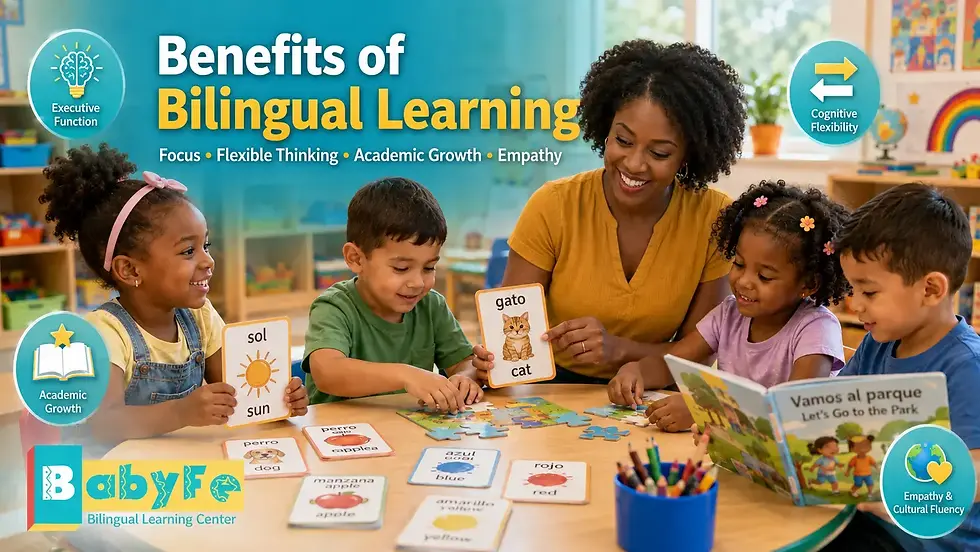
Far from holding kids back, bilingual education has been linked to real, measurable advantages that go well beyond language itself:
Stronger executive function, the mental skill set behind focus, task-switching, and self-control, often develops earlier in bilingual children.
Long-term studies show bilingual students performing as well as, or better than, monolingual peers academically once they reach elementary school.
Bilingual children tend to show greater cognitive flexibility, or the ability to adapt to new rules and switch between tasks.
Added benefits in cultural fluency, empathy, and identity carry into adulthood, well past the school years.
None of that shows up on a two-year-old's vocabulary checklist, but it's exactly what parents are investing in when they choose a bilingual program. One of the easiest ways to support both languages at once, even at home, is reading together, even wordless picture books for toddlers, since kids can narrate the story in either language without getting stuck on translation.
Normal Bilingual Development vs. an Actual Speech Delay
So how do you tell the difference between typical bilingual development and a genuine speech delay? The key is looking at a child's combined language ability, not just one language in isolation. A few red flags are worth a conversation with your pediatrician or a speech-language pathologist, regardless of how many languages your child hears at home:
No words at all by around 18 months, in either language
No two-word combinations by around 24 months, counting both languages together
A noticeable loss of language skills your child previously had
Difficulty following simple directions in either language, beyond typical toddler selectiveness
Limited or no eye contact, gesturing, or social communication alongside limited speech
These red flags apply to every child, bilingual or not; bilingualism itself is never the cause of a genuine delay. A related, very normal phase is when a toddler simply refuses to speak Spanish at home for a stretch, gravitating toward whichever language feels easier. That's not a delay; it's a preference, and it usually passes on its own.
How Spanish-English Immersion at BabyFe Supports Bilingual Education
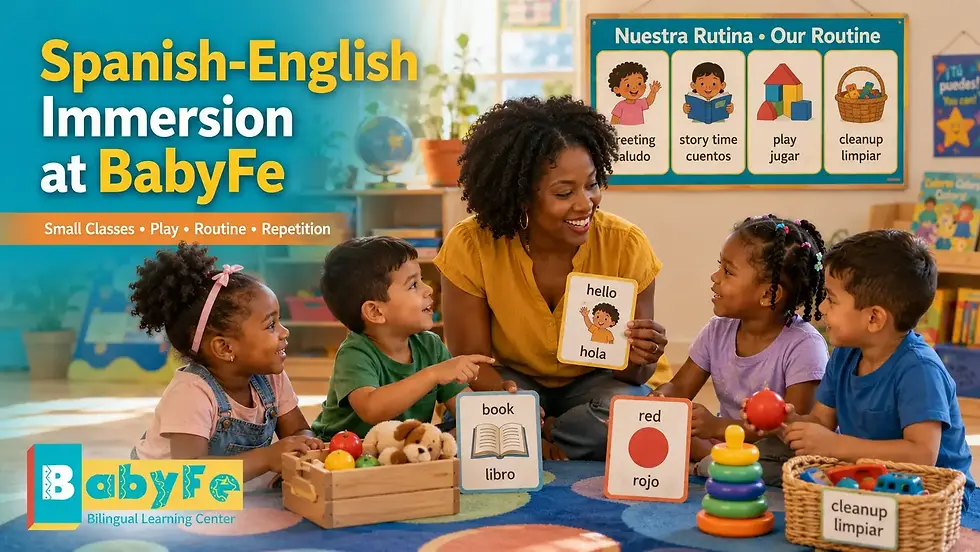
At BabyFe, healthy bilingual development is built into how the classroom runs, not treated as an extra. A few things set the program apart:
Teachers use consistent, predictable language patterns throughout the day so children build strong associations between context and language.
Class sizes stay small enough for individualized attention to each child's language development.
The program is led by founder and educator Michele Coggins, who holds a Master's degree from Teachers College, Columbia University.
Language exposure is paired with play, routine, and repetition, not rote drilling.
Curious what that actually looks like day to day? A Day in a Spanish Immersion Classroom walks through how language, routine, and play fit together from drop-off to pickup.
Choosing the Right Bilingual Daycare for Your Child
Not every bilingual program is structured the same way, and the right fit matters more than the label on the door. Before you commit to a program, it helps to know what to ask on a tour:
Is the program true immersion, or does it mix in significant English-only time?
How are teachers trained in bilingual or dual-language instruction specifically?
What does a typical day's language split actually look like?
How does the school talk to parents about normal bilingual milestones versus real concerns?
Our full guide, Questions to Ask Before Choosing a Bilingual Daycare, walks through each of these in more detail so you know exactly what you're evaluating.
Easing the Transition: Separation Anxiety and Adjustment
Starting any new daycare program comes with an adjustment period, language aside. A few things make the transition smoother for most families:
Keep drop-offs short, consistent, and predictable rather than lingering.
Introduce a simple goodbye ritual your child can count on every day.
Give it two to three weeks before judging whether the adjustment is going well.
Communicate openly with teachers about what's happening at drop-off and pickup.
If drop-offs are the hard part right now, our tips on easing separation anxiety at daycare can help make those mornings smoother.
Tips for Raising a Bilingual Child at Home

Whatever program your child is enrolled in, what happens at home matters just as much. A few strategies make the biggest difference:
Consistency — whether that means one parent speaking one language, or reserving a specific language for certain routines like bath time or car rides.
Reading together in both languages, even if your own fluency is limited.
Celebrating milestones without comparing them to a monolingual sibling's or classmate's timeline.
Staying in close communication with your child's teachers about what they're working on in the classroom.
If you didn't grow up bilingual yourself, raising a bilingual child can feel intimidating — but it's absolutely doable with a few practical, no-guilt strategies, even if you only speak one language fluently.
Getting Ready for the School Year
The start of a new school year brings its own language transitions, especially if your child is moving between a bilingual program and an English-only setting. A quick checklist helps:
Review key vocabulary your child will need in both languages for the new setting.
Talk to new teachers about your child's language background before day one.
Keep bilingual routines going at home even as the school schedule changes.
Watch for the normal adjustment dip in confidence during any big transition.
Our full Back-to-School Checklist for Bilingual Families covers each of these in more detail.
Frequently Asked Questions About Bilingual Education and Speech
Does bilingual education delay speech in toddlers?
No. Research consistently shows children in bilingual education programs meet speech milestones on the same timeline as monolingual children, with combined vocabulary typically equal to or greater than that of monolingual peers.
Is it normal for bilingual children to mix languages?
Yes. Mixing languages, or code-switching, is a normal part of bilingual development and isn't a sign of confusion or delay.
At what age should I be concerned about a speech delay in a bilingual child?
The same general guidelines apply as for any child: no words by around 18 months, or no two-word phrases by around 24 months (measured across both languages combined), warrants a conversation with a pediatrician or speech-language pathologist.
What are the benefits of bilingual education for young children?
Beyond language skills, bilingual education is linked to stronger executive function, improved problem-solving, and long-term academic performance on par with or exceeding that of monolingual peers.
Should I worry my toddler knows fewer words in English than their monolingual friends?
Not necessarily. Bilingual children often have a smaller vocabulary in each language early on, but their total vocabulary across both languages is typically comparable to or larger than a monolingual child's.
The Bottom Line
The research is clear: choosing bilingual education for your child isn't a risk to their speech development; it's an investment in it, along with a long list of cognitive and academic advantages that last well beyond the toddler years. Ready to see it in action?
Start your search for a bilingual preschool near me and schedule a tour at BabyFe, no lingering myths required!


Comments