
Spanish Books for Toddlers That Kids Actually Want to Read Again (2026 Picks)

“Again! Again!” If you’re a parent, you know that phrase can land two ways: pure joy, or quiet dread. I’ve read some board books so many times I could recite them with my eyes closed, and honestly, most Spanish books for toddlers on the market never earn that repeat-read status. They’re too textbook-y, too obviously translated, or just… forgettable. But here’s the thing worth remembering: toddlers learn language through repetition, so the book your child begs for on night 47 is doing far more for their bilingual development than the gorgeous one gathering dust after day one.
Only about 22% of U.S. households speak a language other than English at home, according to recent Census data, which means finding genuinely engaging Spanish-language material takes a little hunting. If you’re already working to raise a bilingual child, the right books make the whole thing feel less like a lesson and more like the best part of the day. Below, we break down what makes a Spanish toddler book re-readable, the best picks by age, interactive standouts, and where to find authentic titles, plus answers to the questions parents ask most.
What Makes a Spanish Toddler Book “Re-Readable”?
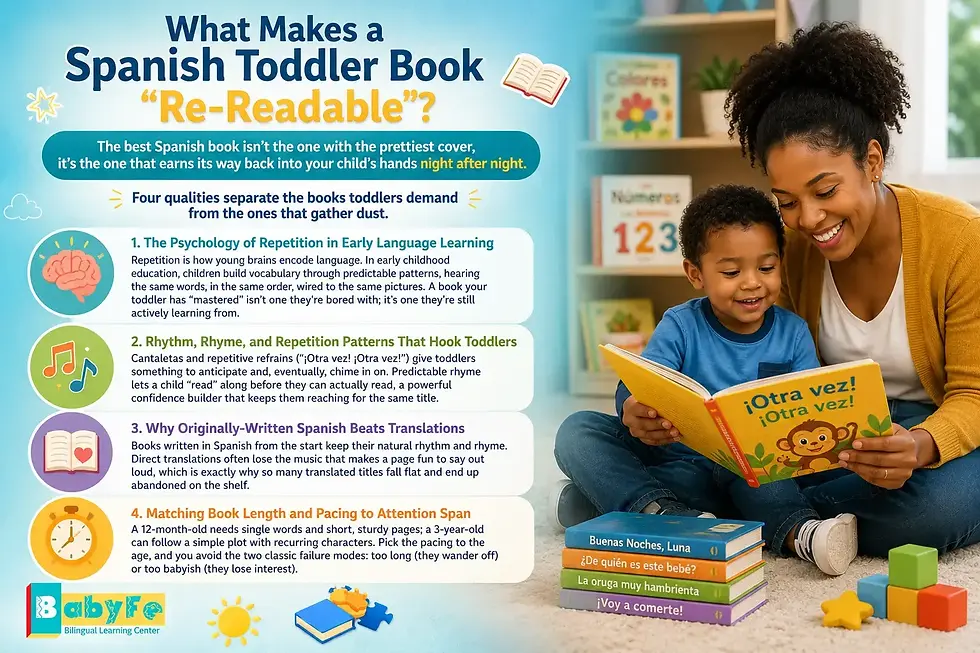
The “best” Spanish book isn’t the one with the prettiest cover; it’s the one that earns its way back into your child’s hands night after night. Four qualities separate the books toddlers demand from the ones that gather dust.
The Psychology of Repetition in Early Language Learning
Repetition is how young brains encode language. In early childhood education, children build vocabulary through predictable patterns, hearing the same words, in the same order, wired to the same pictures. A book your toddler has “mastered” isn’t one they’re bored with; it’s one they’re still actively learning from.
Rhythm, Rhyme, and Repetition Patterns That Hook Toddlers
Cantaletas and repetitive refrains (“¡Otra vez! ¡Otra vez!”) give toddlers something to anticipate and, eventually, chime in on. Predictable rhyme lets a child “read” along before they can actually read, a powerful confidence builder that keeps them reaching for the same title.
Why Originally-Written Spanish Beats Translations
Books written in Spanish from the start keep their natural rhythm and rhyme. Direct translations often lose the music that makes a page fun to say out loud, which is exactly why so many translated titles fall flat and end up abandoned on the shelf.
Matching Book Length and Pacing to Attention Span
A 12-month-old needs single words and short, sturdy pages; a 3-year-old can follow a simple plot with recurring characters. Pick the pacing to the age, and you avoid the two classic failure modes: too long (they wander off) or too babyish (they lose interest).
Best Spanish Board Books for Babies & Young Toddlers (12–24 Months)
For the youngest readers, simplicity wins. High-contrast art, one or two words per page, and pages thick enough to survive being chewed and dropped are the whole game.
Simple, High-Contrast Board Books for First Words
Look for single-word Spanish board books with bold, uncluttered illustrations. The Lil’ Libros first-words series (lotería icons, colors, numbers) and Jen Arena’s Marta! Grande y pequeña pair playful bilingual text with baby-friendly art that holds a young toddler’s gaze.
Spanish Board Books Built Around Daily Routines
Familiar contexts make new Spanish words stick faster. Board books centered on bedtime, bath time, and mealtime let your baby map words like “dormir,” “baño,” and “comer” onto moments they already live every day. Spanish editions of Buenas Noches, Luna (Goodnight Moon) are a reliable starting point.
Where to Buy Durable, Toddler-Proof Board Books
Favor indie bilingual publishers over big-box shelves; the vocabulary tends to be more authentic, and the rhymes actually rhyme in Spanish. Prioritize thick board pages, rounded corners, and wipeable finishes; at this age, a book is also a teething toy.
Best Spanish Picture Books for Older Toddlers (2–4 Years)
Around age two, toddlers graduate from single-word board books to short stories with a beginning, middle, and end. This is the sweet spot many families hit when their little one is starting preschool at age 2, and books become a bridge between home and a more structured learning day.
Story-Driven Books With Recurring Characters
Older toddlers latch onto characters they can’t wait to see again. Simple plots and repeated story beats give them the predictability they crave while stretching their comprehension, the foundation for longer reading later on.
Bilingual vs. Spanish-Only Books: Which Is Better?
A common question at this age is whether to choose bilingual (Spanish-and-English on the same page) or Spanish-only books. There’s no wrong answer; it mirrors the trade-off families weigh when comparing Spanish immersion versus bilingual programs. A healthy home library usually has both. Here’s how they compare:
Factor | Bilingual (Spanish + English) | Spanish-Only |
Best for | Parents who don’t speak Spanish | Deeper immersion & fluency goals |
Main benefit | Let's you scaffold meaning side-by-side | Keeps kids from defaulting to English |
Watch out for | Kids may read only the English text | Harder if no adult speaks Spanish |
Books That Teach Numbers, Colors, and Emotions in Spanish
Concept books do double duty. Titles that name feelings- enojado, triste, feliz, asustado- build vocabulary while supporting the social-emotional learning that’s so central to the toddler years. Counting and color books (Roseanne Greenfield Thong’s Round Is a Tortilla) layer early math and Spanish vocabulary into one reread.
Award-Winning Titles Latino Parents Recommend
Lean on authors that Latino parenting communities return to again and again: Yuyi Morales (Soñadores), Duncan Tonatiuh, and Lucía González, among others. These “buzzy” titles pair rich language with art that rewards a fifth, tenth, and twentieth read.
Interactive & Sensory Spanish Books Kids Beg to Replay

If you want a book to survive past week one, give little hands a job. Interactive Spanish books turn reading into learning through play, and play is exactly what keeps toddlers coming back.
Lift-the-Flap, Touch-and-Feel, and Sound Books in Spanish
The Toca, Toca touch-and-feel series and sturdy Spanish sound books are reliable “again!” generators. There’s a bonus, too: lifting a flap, tracing a textured patch, or pressing a button quietly builds fine motor skills, the same finger control your child will later use for crayons and buttons.
Canciones Infantiles Tie-In Books
Books built around classic canciones infantiles, Los Pollitos, De Colores, La Vaca Lola, let you sing the page instead of just reading it. Melody plus repetition is a memory superpower for toddlers, and songs they already know become instant favorites in book form.
How Interactivity Extends a Book’s Shelf Life at Home
A flat story can feel “finished” after a few reads. An interactive book never fully is; there’s always another flap to lift or sound to trigger, so it doubles as playtime, not just reading time, and stays in rotation far longer.
How to Build a Spanish Reading Habit Toddlers Actually Enjoy
Consistency beats intensity. For more day-to-day tactics, our Spanish tips for toddlers guide is a great companion, but these four habits do most of the heavy lifting.
Make It a Ritual, Not a Chore
Same cozy spot, roughly the same time, no quizzing, no correcting. When Spanish reading is a low-pressure ritual instead of a lesson, toddlers stop resisting and start requesting. Attach it to an existing anchor, right after the bath, right before lights out, and it sticks.
Let Your Toddler “Choose” the Reread
That little bit of autonomy is a huge engagement booster, even when it means Los Pollitos Dicen for the fifth night running. Offer two or three books and let them pick; the sense of control makes them far more invested in the story that follows.
Mixing Spanish and English Books Without Confusion
Worried that alternating languages will confuse your child? It won’t. Toddlers sort two languages remarkably well, and a little code-switching, blending words from both in one sentence, is a normal, healthy sign that the brain is juggling both systems. You don’t need separate rooms for each language; you just need to keep reading.
Signs Your Toddler Is Absorbing Spanish Vocabulary
If your toddler isn’t repeating words back yet, don’t panic; comprehension almost always comes before production. If you’re wondering when your child will actually start speaking Spanish, watch for the quiet wins: pointing to the right picture when you ask “¿dónde está el perro?” is a real milestone. The words will follow.
Where to Find Authentic, High-Quality Spanish Children’s Books
Once you know what to look for, the next challenge is sourcing the good stuff and avoiding the duds.
Independent Latino-Owned Publishers and Bookstores
Independent, Latino-owned publishers and bookstores curate for authenticity and are worth supporting. Their catalogs skew toward originally written Spanish titles, which means better rhyme, richer vocabulary, and fewer stiff translations.
Library Resources and Bilingual Story-Time Programs
Your local library is a goldmine. Many branches offer Spanish and bilingual story-time programs, so you can test-drive titles and see which ones actually hold your toddler’s attention before you spend a dime.
Subscription Boxes and Curated Bilingual Book Clubs
Curated bilingual subscription boxes and book clubs do the hunting for you, delivering fresh, age-matched picks each month. If a home library has you thinking bigger about immersion, a dual-language preschool near you or a program staffed by multilingual educators can reinforce at school what those bedtime books are planting at home.
Red Flags: How to Spot Poor or Overly Literal Translations
Watch for translations where the English clearly came first. If the Spanish reads stiff, loses its rhyme, or uses phrasing no native speaker would say out loud, skip it; those are the books that never get reread.
Frequently Asked Questions About Spanish Books for Toddlers
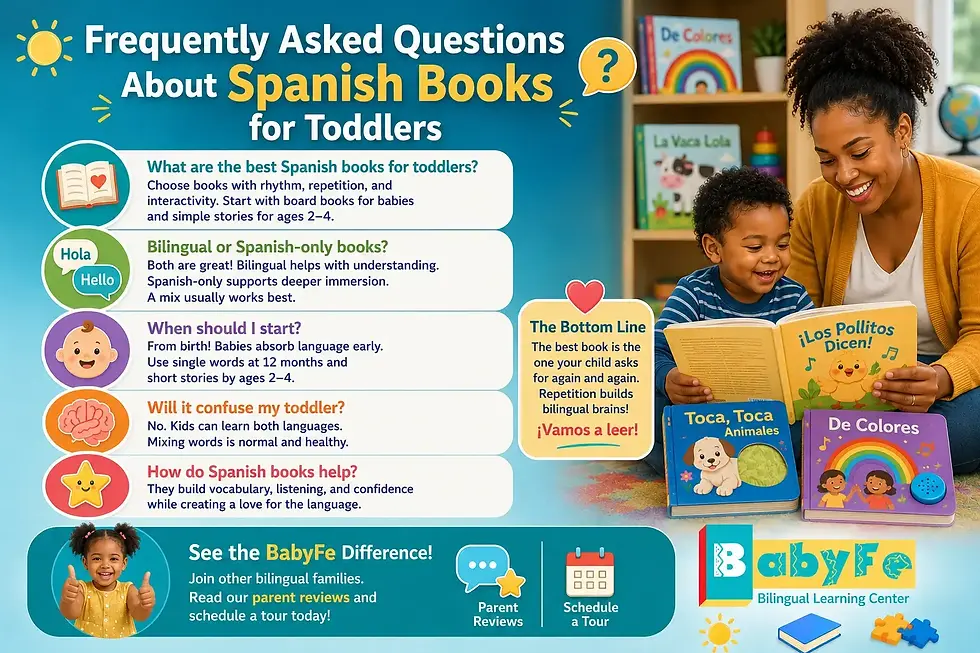
What are the best Spanish books for toddlers?
The best Spanish books for toddlers are ones with rhythm, repetition, and interactivity, the qualities that earn repeat reads. For babies, choose single-word board books built around daily routines. For ages 2–4, pick story-driven picture books with recurring characters and originally written Spanish rather than stiff translations.
Are bilingual or Spanish-only books better for toddlers?
Both work; it depends on your goals. Bilingual books help parents who don’t speak Spanish scaffold meaning side by side. Spanish-only books push deeper immersion and keep kids from defaulting to English. A balanced home library usually includes both formats, matched to your family’s Spanish comfort level.
At what age should I start reading Spanish books to my child?
You can start from birth. Even before they understand words, babies absorb the sounds and rhythm of Spanish. Around 12 months, single-word board books work well; by ages 2 to 4, toddlers can follow short, story-driven picture books. Earlier exposure simply builds a stronger foundation.
Will reading both Spanish and English books confuse my toddler?
No. Research consistently shows that young children can learn two languages at once without confusion. Occasional code-switching, mixing words from both languages in one sentence, is a normal, healthy stage, not a sign of trouble. Keep reading in both languages, and your toddler will sort them out naturally.
How do Spanish books help with bilingual development?
Reading builds vocabulary, listening comprehension, and a positive association with Spanish long before a child speaks it. Repetition encodes new words, illustrations anchor meaning, and shared reading time turns language learning into connection, all of which accelerate bilingual development during the critical early years.
The Bottom Line
The “best” Spanish book for your toddler isn’t the one with the prettiest cover; it’s the one they drag off the shelf for the fifth night in a row. That repetition isn’t annoying; it’s the whole point, and bilingual development thrives on it. Start with one or two titles from this guide, watch which becomes the household favorite, and build from there. ¡Vamos a leer!
Curious how a full Spanish-immersion environment builds on this at BabyFe? See what other bilingual families are saying in our parent reviews, then reach out to schedule a tour.


Comments